
1
Nick Osbaldiston
The key goals and objectives of this chapter are to understand the following:
- the concepts of culture and identity in sociology
- foundational theories of culture and identity in classical sociological literature
- contemporary theories and sociological work in cultural sociology
- contemporary theories and sociological work in symbolic interactionism
- engage case studies/examples for deeper analysis.
Overview
As the previous chapter discussed, sociology has its roots in the turn towards science during the Enlightenment period and beyond in the 19th and 20th Centuries. As sociology started to expand throughout the Western world, so too did the different sites of social life that it sought to interpret and understand. While class and status remained important concepts for sociological examination, new ideas and concepts like ethnicity, gender, culture and identity grew in popularity. Importantly, these concepts allowed sociologists the opportunity to develop their own ‘style’ of sociology as we will see in this chapter. Like any discipline, sociology has many different approaches that privilege certain variables in the development of theory and research. In this chapter we will examine some of these in detail, however, there are far too many different fields of inquiry to cover here. Rather, we will focus on some of the major contributions to identity and culture in what follows. However, later in this textbook, you will find other important concepts such as politics, deviancy, technology, health, ethnicity, gender and sexuality, that all feed into the discussion around identity and culture.
Some Key Background Concepts and Ideas
Of the many different concepts you will learn about, culture is one of the most difficult and slippery to define and identify. Early meanings given to culture, especially out of anthropology, identified it as the system of morals, values, laws, customs, rites and rituals that underpin a community or society. Other anthropologists like Clifford Geertz (1973) defined culture as a whole system or way of life that includes not just morals and laws, but also artifacts, rituals, social interactions and layers of meaning invested in everyday life. Over time, however, and through sociological insights, culture has been interpreted by theorists through different conceptual lenses. Georg Simmel (1858–1918) who you will encounter below, considered culture to be a complex relationship between how people engage with the world symbolically, and how different facets of cultural life (such as art) created meaning for people’s lives.
On the other hand, Emile Durkheim (1858-1917) and his students focused on culture being a great organiser of morals and values, as people come together in collective energy and unite around sacred things (see below). In recent years, cultural sociologists who follow the Durkheimian tradition use notions of collective values and the binary opposition between the sacred and the profane to understand all aspects of cultural life from war, political discourse, incivility, place and even sport.
Conversely, postmodernists like Jean Baudrillard (1983) contended that culture is effectively made up of signs and symbols, many of which become like language in everyday life. We use these signs and the cultural artefacts around us to demonstrate our identities or portray certain characteristics about ourselves in everyday life. Consider for instance the red rose. On its own, the rose is simply a flower, that has a certain texture and character to it. However, through cultural meaning, and shared understandings of what the red rose signifies, we understand it to be part of the ritual of love or romance. For Baudrillard (1983) though, our culture is filled with things that are representations or symbols of reality, but which have for him become ‘real’. A classic example would be a chicken nugget. Layers of symbolism have been advertised/marketed to us over the years presenting this as ‘real’ chicken. The reality is that the ingredients are a mixture of chicken and other additives. Furthermore, ‘chicken’ has bones, gristle, skin, and so on. Whereas the chicken nugget removes all of this. For Baudrillard (1983), much of our modern experience is now filtered through what he calls the simulacra of life – the fantasy, the unreal, the fake, now presented as real – so that it becomes ‘real’ to us.
American sociologist Anne Swidler (1986) utilised some of these approaches to develop a sociological understanding of culture as ‘meaning-making’. From her perspective, culture can be seen as a ‘toolkit’ where individuals use different ideas to unpack and make meaning out of different social situations in modern life. While individuals draw from cultural resources to assist them in understanding their lives, they also through their actions remake culture, creating social change. In other words, culture does not stay stagnant for Swidler (1986) and individuals are not simply governed by cultural norms, morals and values. Rather, individuals have agency, and will selectively use tools to assist them in meaning-making, in active ways. From this perspective, culture can be a driving force for social change (not always in positive directions) and as you will see, cultural sociologists like Jeffery Alexander and Philip Smith (2018), argue that culture is an independent variable, rather than a dependent one. For instance, Smith (2008) in his book on punishment argues that it is culture, not the nation-state and not disciplinary expertise, that pushes for change in punitive systems. This is contrary to such arguments from others such as Michel Foucault (1975).

Of course, culture can also denote the artifacts and activities that people participate in across society. This is where we can distinguish potentially between classes, or status (see prior chapter), where individuals from higher classes might participate in ‘high culture’ whereas others in ‘low culture’. Critical theorists (and Marxists) Adorno and Horkheimer (1997) in their examination of the Culture Industry critique cultural life by arguing that our obsession with things (material objects and commodities) take us away from authentic matters such as our human condition or social relations (Woodward, 2007). In particular, the culture industries no longer serve to produce social good or challenge status quo thinking. Rather, as they argue, it serves only capitalism – and profit. Furthermore, the cultural industries distract people away from understanding and challenging the exploited nature of capitalism. For these theorists, and others who formed what is known as the Frankfurt School, culture industries, along with consumerism, serve only to uphold capitalism and repress revolutionary potential.
As alluded to above, the link between our culture and who we are as ‘selves’ is important in sociological analysis. Instead of discussing the ‘self’, which philosophers tend to focus on, sociologists often use the term identity. Identity refers in principle to the complex make-up of who we and others think we are. Identity emerges from our socialisation throughout our youth, but also in our relations to culture, context, other people and of course, biological, psychological, and genetic make-up (though sociologists have avoided these last three matters – see below). The difficulty we face when discussing identities is to balance issues like genetics, with the broader environmental contexts that impact who we are as people. This is difficult to assess at times, but sociologists try to explore the way social interaction occurs, and how this impacts our understanding of who we are, and the roles we play in everyday life.
Most sociological theorists are interested in identities, but a group of American scholars known as the symbolic interactionists that included significant names such as George Herbert Mead (1963-1931), Herbert Blumer (1900-1987), Erving Goffman (1922-1982), Harold Garfinkle (1917-2011), Robert Park (1864-1944) and pioneer female criminologist Ruth Shonie Cavan (1896-1993). Fundamental to the development of this approach was Mead who argued that our experiences as individuals living in everyday life are essentially social. In other words, every day, you and I engage with others, humans and non-humans, which have symbolic meaning to us. We communicate with each other, share interactions with one another, and adopt different roles in each context because of this interaction we share. We will explore this in more detail below in the chapter.
Of course, identities are made up of different layers of sociological constructs from gender (see chapter on gender), ethnicities (see chapter on ethnicity), class (see chapter on class) and ideologies (see chapter on political sociology). In this contemporary age where social media is so prevalent, identities are challenged daily by digital data and our interactions with one another online (see chapter on digital sociology). Generally, sociologists tend to agree that modern life has become less governed and structured by traditional norms and values, as well as institutions. British sociologist Anthony Giddens (1991) for instance argues in his seminal work Modernity and Self-Identity, that identities are freer than ever before. We have become, for Giddens (1991), critical of past traditional institutional norms, such as marriage, and subsequently make our own lifestyle choices accordingly. The choices we make impact who we are, and for Giddens (1991), individuals in modernity now create their life biographies or narratives via them. While we are freer than ever to make these decisions, they come also with risks. While in the past in traditional premodern societies, your choices such as occupation were more or less made for you, in late modern societies your choices are open, but also laden with risks of failure. Thus, people become reflexive, examining carefully the choices available to them, weighing up options, and importantly, consulting widely with different expertise before making a choice (see also Beck, 1992; Bauman, 2005). For someone like Giddens (1991), but also Bauman (2005) and Beck (1992), we have no option but to make lifestyle choices now and face the consequences of our choices without the support of traditional institutions and the state.
There is only so much space that we can dedicate to all these ideas. At the end of the chapter, there is a list of recommended readings that may prove useful if you want to know more about concepts and ideas not covered below. However, what follows is a curation of ideas/theories/concepts on the topics of culture and identity. We focus here specifically on the development of the sub-disciplinary area of cultural sociology through Emile Durkheim’s initial work on religion, the more bleak approaches to culture via Georg Simmel and Max Weber, and the symbolic interactionist approach to identity via social interaction. As noted already, most of the chapters that follow this delve into other sociological concerns of ‘identity’ and ‘culture’, including questions of gender, race/ethnicity, global politics, deviancy and crime, and our ever-growing digital lives.
Cultural Sociology: Durkheim and Beyond
One of the most pivotal thinkers you will hear about in most sociology textbooks is that of the French sociologist Emile Durkheim (1858-1917). Durkheim is considered to be the father of French sociology and also has been labelled as one of the most important figureheads in the development of the discipline generally. Often, the Frenchman is attributed to the school of thought known as ‘functionalism‘. However, Durkheim had a significant impact on the development of a sociology that is attuned to the question of culture, and the influence that it has on social change or cohesion.

Influenced by a number of thinkers including Auguste Comte, Durkheim initially started his sociology by exploring and examining society from a macro perspective (Turner et al., 2007, p. 279). This is evident especially in the widely cited (and taught!) debates he had through The Division of Labour in Society (1893/1964) where Durkheim laid out his concern for the transformation of the organisation of the social. In particular, Durkheim (1893/2013) was worried about how integrated individuals would feel in a society that was shifting dramatically into diversified roles and expectations. In short, Durkheim (1893/2013) emphasised the need to understand how to keep people socially integrated, in an increasingly individualised society. As Turner et al. (2007) suggest, it is this concern that underpinned Durkheim’s work and influenced others right up until today.
Three major points need to be made here to provide the foundation for Durkheim’s later and more influential work on religion in relation to culture. Firstly, Durkheim (1893/2013) emphasised the importance of collective values, ideas and norms in his work, labelling this the ‘collective consciouness or ‘collective representations’. We can see this, in his words, as “the totality of beliefs and sentiments common to the average members of a society forms a determinate system with a life of its own. It can be termed the collective or common consciousness” (Durkheim, 1893/2013, p. 63). We might prefer here to term this ‘culture’ – as culture holds all of our collective values, ideas, norms and expectations of which we ascribe to. As individuals, we both add to this through our actions, but also are constrained by it. For instance, consider an everyday life norm such as civility and good manners. There is a cultural expectation placed upon us to say ‘please’ and ‘thank you’, while we also hold others to account in this regard as well. This is the collective consciousness, for Durkheim (1893/2013), in action.
Secondly, Durkheim (1893/2013) argued that modernity led to the transition of society from what he called mechanical to organic social solidarity. Premodern societies were often characterised by their small community/communal setting, often bound together by kinship ties, well-defined roles, and importantly, socially defined by strong collective conscience – what he terms mechanical solidarity. Importantly, societies like these are often deeply religious, with a collective commitment to sacred values and collective worship. Conversely, contemporary societies, such as big cities that expanded greatly through early modernity, were characterised by large-scale populations, bound together by diverse and impersonal ties (especially through exchange in a capitalist market), and weaker collective consciousnesses – what he terms organic solidarity. Unlike mechanical solidarity, societies that evolve in this state tend to be secular or hold to religions that are largely individualised (in other words, emphasise individual worship, rather than collective worship).
Thirdly, Durkheim (1893/2013) envisioned the transition into organic solidarity as somewhat inevitable for Western societies like France. This raised concerns for Durkheim that individuals would fall into ‘anomie’. This refers to the transition of society to one that emphasises the individual, drawing them away from the collective, towards their own interests, their own values, their own ambitions, and so on (Lukes, 1973). This was a concern for Durkheim (1893/2013) for individuals would become less integrated, deeply isolated, and exposed to the crushing nature of capitalism and the industrialisation of life. Furthermore, and somewhat like Marx and Engels, Durkheim (1893/2013) thought that it would inevitably lead to social unrest and potential revolutions. Thus, it could be argued that Durkheim’s (1893/2013) fundamental concern was how modernity was turning people into individuals who felt no connection to their society, or culture.
This anxiety towards the future of modern society led Durkheim (1912/1995) to analyse religions across societies considered premodern in his work entitled The Elementary Forms of Religious Life. Using ‘totemic’ cultures from some of the Aboriginal nations of Australia, Durkheim (1912/1995) attempted to understand what were the building blocks of religious/spiritual life, in places that still represented mechanical solidarity. It is important to note, that the Frenchman never undertook ethnographic work in any of his work. Rather in this work, Durkheim (1912/1995) relied on the ethnographies of others like Baldwin Spencer and Francis Gillen’s The Native tribes of Central Australia (1899). Subsequently, there are errors that we are aware of now in contemporary society including the criticism that trying to find the roots of religion in Indigenous Australians was nonsensical. For Geertz (1973), this was Durkheim trying to impose his already established heuristic onto a people who the theory did not really fit. Nevertheless, Durkheim’s (1912/1995) theory has had a significant impact on both anthropology and sociology since publication.
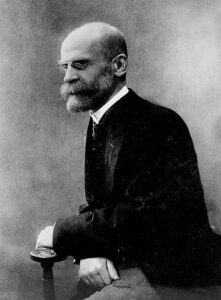
For Durkheim (1912/1995) religion is fundamentally based on the sacred, and the opposition this has to the profane. The world for him is divided between these two poles – the sacred, being those things, ideas or beings which society attributes “virtues and powers” to, and the profane, being the everyday world around which the sacred requires protection from (Durkheim, 1912/1995, p. 34). The sacred can be anything for Durkheim (1912/1995, p. 35), “a rock, a tree, a spring, a pebble, a piece of wood, a house, in a word anything”, even people. What is important for him is less the item of interest, but rather the power the item has to a community or society because of the collective valuation they place on it. These sacred things/beings, importantly for him, must be protected from the defilement of everyday life, otherwise it would lose that value. Following this dichotomy of the sacred and profane, Durkheim (1912/1995, p. 44) arrived at the conclusion that religion, “is a unified system of beliefs and practices relative to sacred things, that is to say, thing set apart and forbidden – beliefs and practices which unite into a one single moral community called a Church, and all those who adhere to them”. In all religions, you will find the sacred for him – around which is organised worship, rituals, and rites.
Important to Durkheim (1912/1995) is less the sacred objects themselves, and more the interactions that occur around them. The organisation of people, coming together in a collective revelry, ritualistic worship and even a “state of exaltation” (Durkheim, 1912/1995, p. 220). He saw religion as enacting a type of force that enabled people to feel that they belonged to something larger than themselves, which would ultimately achieve two main points. One it would allow people to feel connected and integrated into a wider community whole, and second, it would provide a place for the reinforcing of commitment to the morals and values of the collective. In short, religion allowed people to feel like they belonged to larger than themselves – and then recommit to a wider culture.
For Durkheim (1912/1995), the building blocks of religion might hold the secret to overcoming the ills of modernity. Religion for him would not survive in a secular modernity – much like what Marx and Engels argued. However, instead a new ‘sacred’ might be created or appear that allows similar collective membership and belonging. He saw, importantly, that it might well be the state and nation that take the place of religion – creating sacredness organised around what it means to belong to the country/culture. Consider the national flags that adorn our public places, or the flags that represent our culture/ethnicity. These in particular provide a sense of identity, along with organising us into collectives and at times, are sacred in that we perform rituals under them such as singing the national anthem. In some cases, it is a significantly immoral thing to desecrate the flag, even to the point of imprisonment in some nation-states. Or consider the sacred power of the emblem for a sports team. Importantly here, the crest of your favourite sport’s team identifies you as one of the fans, but also separates you from other fans of other clubs. This is then intimately tied to your identity.
Durkheim’s students continued to work on the sacred alongside him and well after his death in 1917, focusing on the nature of these imaginative templates in cultural life. For instance, Henri Hubert (1905/1999), researched the nature of sacred times cut off in the calendar of everyday life such as Christmas or other religious festivals that served to bring people together in collectives. Durkheim’s own nephew Marcel Mauss (1906/2013) also examined the nature of seasons for Inuit people showing that wintertime in particular was full of certain intense religiosity and important taboos. He also is famous for his work on the nature of gift-giving, showing that the practice of reciprocal gift-giving as a form of cultural exchange is not limited to Western societies (Mauss, 1925/1990) which has had a tremendous impact on anthropology. Robert Hertz (1909/2009) examined how in rituals, the right hand would often be the one used, whereas the left would be considered the evil, or profane. Hertz (1909/2013) also emphasised the dual nature of the sacred, being both something that can inspire and create collective emotional energy, but also horrify and distress creating tension and anxiety. Anthropologist Mary Douglas’ (1966/2003) masterpiece Purity and Danger follows a similar trend in the analysis of society broadly through the twin poles of purity and pollution. For her, tracing the meanings of dirt to different societies, what is considered clean and unclean is a matter of cultural context – and laws/taboos/norms around these were cultural forms of boundaries. What is right, what is wrong, what is clean, what is unclean – are all the result of wider cultural ideas and values contextualised by place and time.
Since Durkheim’s (1912/1995) engagement with the sacred as a concept, there has been significant work across the social sciences grappling with how it operates in modern culture. Riley (2010) illustrates in his work that the intellectual habitus built into modern intellectual life, especially in France, of researching the sacred, the profane, rituals and taboos, led major theoretical works from George Bataille, Jean Baudrillard, and even Michel Foucault. However, it is within cultural sociology today that we see the impact of Durkheim (1912/1995) more acutely.
There is a division between those who study culture in sociology and those who are cultural sociologists. Sociologists of culture examine aspects of our modern lives that are shaped, produced or altered as a result of outside forces. For instance, Max Weber’s rationalisation thesis argued that modern cultural practices, such as art or music, were being heavily routinised and disenchanted as rules or norms on how to do it appear, to be efficient, but also effective in profit making. Cultural sociologists on the other hand argue that society, and the institutions/structures within them, are at their core cultural. The ‘new’ Durkheimians such as Jeffrey Alexander and Philip Smith (2018) construct a program of cultural sociology that envisions cultural codes, values, ideals, and imaginative life, as a collective force on structures in our society. In other words, culture is independent, it enables us to make meaning of the world, experience it, and at times change it. Conducting analysis on culture requires unpacking the imaginative templates, like the sacred and the profane, impure or pure, good and evil, that culture uses to make sense of the world around it, but also at times govern or change it.
Several scholars have emerged in sociology down here in the south organised under this umbrella. For instance, Brad West (2022) unpacks the nature of Australian and New Zealand tourism to Gallipoli (the site of one of the first conflicts in World War One for Australian and New Zealand troops – ANZACS) as a form of cultural pilgrimage embedded with deep meaning. He argues that these trips are symbolic, and when amongst the sites of war at the place of Gallipoli, individuals are collectively engaging in the sacred through ritual. Osbaldiston and Petray (2011) also argue that these are places where people experience both the positive affirmation of the sacred, but also the negative horrors of it when confronted with symbols of death. Others such as Ian Woodward (2007) spend time locating the cultural force that we give to objects and the cultures that form around them such as we can see in vinyl record collecting today (Bartmanski & Woodward, 2018). Margaret Gibson (2008) further examines the ways objects of the dead, surround us personally and are invested with significant value, and power, long after people have passed away.
Important to cultural sociology then is a collective narrative or theme, that underlines our cultures which produces agreement on certain things, but also governs behaviour. For instance, Philip Smith (1999) shows in his paper on place, how cultural framing of certain places can impact how one behaves when in that area. In some cases, places might have a sacred quality to them, which encourages a reverent tone, or a quiet solemn approach.
For instance, walking to the Pool of Reflection in the War Memorial in Canberra, an individual must walk past the names of fallen men and women in combat. The cultural narrative here is one of reverence for those passed. What do you think would happen to someone who violated these norms? For Smith (1999) though, there are other places too – ones that horrify and disgust us creating rituals of destruction or avoidance. There are also places that encourage the unshackling of restraints where morals are loosened – such as a casino. Here, places are defined by ‘letting loose’ – such as Las Vegas. As you can see, however, cultural sociology today tends to examine how cultural templates or imaginations such as the sacred, exist and influence society today.
The Rationalisation, Disenchantment, and Tragedy of Modern Culture?
One of the figureheads of sociology that you will hear mentioned a lot in this text and in others is that of the German sociologist Max Weber (1864-1920). Best known for his approach to sociology through the ‘interpretivist’ tradition (see chapter on methods), Weber’s sociology was founded on an approach that tried to examine society from an individual standpoint. In particular, unlike Durkheim and others, Weber’s approach to sociology was one which rejected the positivist approaches to research. Instead, he argued that understanding modern life could only be achieved by interpreting individual social actions. The individual becomes both an actor but also a reflection of the society that they live within.
Aside from his methodological positions, Weber (1919/2012) also produced some of the most important sociological theories of modernity, including his concept of rationalisation and disenchantment. Put simply, Weber argued that in premodern life, before the enlightenment period and especially before the scientific advancement of knowledge, societies or communities acted in accordance to myth, religious or spiritual information. Life in this state, for him, presented to people a mystical reason for different events, but also provided life with a certain unknown quality with attribution for it given to the gods or divine above. For instance, if a natural disaster struck, this was the work of the gods in divine punishment or discipline of their people. As such, life had a mystical quality that could not be weighed, measured or understood. God’s ways are mysterious, as the biblical saying goes.
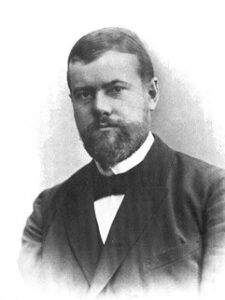
For Weber (1919/2012) the period of Enlightenment advanced scientific knowledge significantly, creating rational knowledge about the world that we live in. Things could be measured, understood, and unpacked scientifically – also known as rationalisation and disenchantment for him. From his perspective, science is like the metaphor of Pandora’s box. Once opened, the world as mysterious, unknown and mythical would never again be recaptured, and life would increasingly be dominated by the rational knowledges. In his famed lecture Science as a vocation, he argues the following:
It is the fate of our age – with the rationalisation, the intellectualisation and, above all, the disenchantment peculiar to it – that precisely the ultimate and most sublime values have withdrawn from the public sphere, either in the realm of mystical life in a world beyond the real one or into the fraternity of personal relations between individuals. (Weber, 1919/2012, p. 352)
Modernity, and the modern push for rational ways of understanding life, meant that not just the sciences, but all spheres of modern life would become rationalised eventually. Weber (1905/2002, p. 13) described the culture that developed as a result as a hard “immutable shell” in which individuals are “obliged to live”. Everything is subjected to rationalisation. Life for him has become cold, calculating, intellectualised and reasoned. Not only does this extend to the most obvious places, such as the economic world where goals can be achieved through heavy statistical calculation, but also for Weber across cultural life, the aesthetic, the political and even the romantic. The point for him is that in each area of culture, we develop a strong understanding of how to do this most effectively, and efficiently, to achieve goals. Consider dating in the contemporary age as an example. Dating you could argue once was achieved through luck, opportunity, or chance. Love was conceived of, almost as mystical. However, dating services and apps, via scientifically measured and constructed algorithms, attempt through probability to match people with those who, statistically speaking, will lead to a successful relationship. What does this do to romance? For Weber, it reduces it rationally, removing the irrational from the equation perhaps.
For Weber (1919/2012, p. 348) though, the more widespread and deeply embedded this process of disenchantment happens, the more likely it is that people will also seek out the irrational. As Barbara Adam (2009, p. 11) describes it, rationalisation means we yearn for “spiritual fulfilment, sublime values, and in the most general sense, all that escapes the iron grip of rationality in the social world”. It also meant for Weber an increase in an appreciation for those leaders who might buck the ‘status quo’ through charisma in modern politics (see political sociology chapter). In short, as life grows ever more calculative, and in some respects predictable, individuals will seek out escape within cultural life. The interesting question for us might be whether that does exist in our contemporary culture today? What areas of cultural life do you see us seeking out for the ‘irrational’ or the ‘sublime’?
American sociologist George Ritzer (2010; 2011) throughout his career adapts Weber’s thinking through his analysis of modern society. Initially in his book The McDonaldisation of Society, Ritzer (2011) argues that our institutions, including our cultural life, are standardised, predictable, efficient, and controlled. Ritzer (2011) bases his theory on the organisation and production cycles found in McDonalds. He contends that this giant food chain operates on the principles of rationality that Weber described. Everything is standardised in McDonalds, managed and controlled with precision, to produce food in the most efficient, quick, and cost-efficient manner. Additionally, the fast-food chain grew successfully across America, and the world, creating a standardised experience for all. In short, you can enter any McDonalds and expect some of the same food on the menu. Ritzer (2011) argues that this reflects cultural life generally as well. Art, literature, movies, sport, leisure and other forms of our culture are heavily standardised, and predictable, based on efficiency and cost-effectiveness. Above all, the corporations and businesses that operate within our cultural life know what ‘sells’, and will produce commodities, artifacts and productions based on this knowledge. We might ask if Ritzer (2011) is right – does our cultural life seem to follow the same model of a McDonalds? Does our cultural life seem overly predictable and standardised? Consider movies for instance. Are they mostly predictable today?
Ritzer (2010) also examines our attempt to re-enchant our culture through the spectacle of consumption. Using examples like Las Vegas, the shopping centre, sports stadiums, universities, and tourist locations, Ritzer (2010) argues that the owners and businesses in these places create magical worlds and spectacles to construct what he calls “cathedrals of consumption”. Take for example the shopping centre, which is fundamentally a place for consumption, or the buying of goods and services. Ritzer (2010) contends that these are now quasi-religious places, where we gather not just to shop, but also to eat food, watch movies, enjoy entertainment, and have fun. Also, these places create landscapes within to blur boundaries between the real and the unreal – for instance the building of mini eco-systems including trees and ponds (coupled with fish!) inside. The shopping centre is therefore a place of experience, not just to consumption. For Ritzer (2010) this is just one example where consumerism attempts to re-enchant life with the spectacle. However, the spectacle is also only designed to do one thing, to keep you inside the walls of the place, and to keep you consuming.

Not all agree with Weber and others like him, however. Social theorist Jane Bennett (2001) argues in her work The Enchantment of Modern Life that there is still much that is wonderful in a world that has been made ‘known’ by science. She argues that modern life is full of enchantment and the unknown – arguing especially that in the sciences, wonder on how organisms work, even the most mundane things, is deeply meaningful, enlightening and enchanting. This also includes of course, some of the bigger questions that we have around the nature of our universe, and the sublime feelings that come from knowledge of how large and expansive it is. Furthermore, Bennett (2001) contends that to be ethical in a modern world, we need these experiences of enchantment in order to create empathy, generosity and produce deeper meaning in our lives. What do you think of her argument and that of Weber’s? Is there wonder and enchantment still in our cultural life? Or is the world increasingly predictable, rational, efficient, and calculable?
Another name you will hear often in sociology is that of the German sociologist and contemporary of Weber, Georg Simmel (1858-1918). Simmel was much less recognised than his peers however, mostly due to the essayistic style of his work and metaphysical approach to sociology which covered everything from the bridge, the door, the meal, the adventure through to larger deliberations on economic life in his book The Philosophy of Money. However, Simmel’s work on culture follows a similar trajectory as Weber in that he foresaw concerns within the direction of modernity. In particular, Simmel (1991) argued that culture can be divided into two areas, objective and subjective. Objective culture, represented as the cultural forms, institutions and artifacts in our society generally – for instance, the technologies, arts, religions, government, norms and so on. Simmel (1991) argued that we use these as obligatory points through which we cultivate ourselves – and make sense of our place in the world. Take for instance literature or the arts, used, he would argue, to reflect on who we are as individuals, but also our place within the wider culture. For Simmel (1991), objective culture like this is important for a society to grow and develop – but also give a sense of self and connection to individuals – which he describes as our subjective culture.
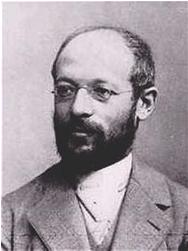
The ‘tragedy’ of modern life for Simmel (1991) however is that modern objective culture has grown too large, and has become separated from the needs of subjective culture (us). He argued that objective culture has become “independent” imposing its “content and pace of development on individuals, regardless of or even contrary to the demands that these individuals ought to make for the sake of their own improvement, that is the acquisition of culture” (Simmel, 1991, p. 91). The objective cultural world has developed its own logic, and reason for being, independent of the need to produce meaning or cultivate individuals in society. However, these industries demand of society that they know of them, engage with them and consume them. In other words, objective culture has dominated cultural life to the point that these things, institutions, and industries dictate individuals on how to live (Pyyhtinen, 2018, p. 119). As Pyyhtinen (2018) illustrates, consider how much fashion and other ‘stylistic’ industries dictate how we consume but also dress ourselves and thus create our identities. Or consider how movies or music have dominated our cultural lives, no longer serving to increase understanding, but rather simply existing to make money. For Simmel (1991), the tragedy in all this is that we lose our place for cultivation, and become overwhelmed by objective culture. This includes not simply culture industries like movies, but also bureaucracies, governments, institutions, and so on.
Later in his life, Simmel (2010) turned towards trying to understand life generally in relation to culture and how individuals develop their ethics or ‘ought’ on how to live. Simmel (2010) developed a complicated approach to this. However, we simplify it as a constant negotiation between our life experiences and our personal reflections. In other words, the world that we inhabit and the relations we have with others (throughout our lives), create the foundation for what we feel life ‘ought’ to be (Simmel, 2010). Subsequently, there is no overarching objective ‘truth’ that emanates from culture from above (contrary to Durkheim), rather our own personal ethics on, for instance, the ‘good life’, emerges through a constant negotiation, reflection and experience of everyday life with others. Thus, our understanding of what we ‘ought’ to be thinking, feeling and doing is in constant flux – always changing with our relationships around us, impacting on our choices and how we understand and make meaning. This is what we call in sociology ‘relational’, which effectively means that much of our social, cultural and individual lives is shaped by the experiences and relations we have with others. This approach of Simmel’s in some ways is the foundation of another group of theorists called the symbolic interactionists.
🔍 Look Closer: Simmel and city life
Following the theme of the overtaking of objective culture over subjective life for Simmel, is the famous essay he wrote in 1903 entitled ‘The Metropolis and Mental Life’. In this highly insightful essay, Simmel (1991) argues the following:

- In large cities, people become socially reserved, not wanting to talk to others and keeping largely to themselves
- People also become ‘blase’, or dulled, to the world around them, as the cities assault their senses with lights, sounds and smells.
- The city is the home of capitalism, and as such is a vibrant, large commercial hub, creating a mammoth amount of cultural artifacts – this overwhelms the individual as stated above.
- The city allows for people to hide away, and not be too exposed – one can become part of the crowd by dressing similarly and not standing out.
- However, unlike the country or rural places, city folk do not have as much connection to one another. He infamously argued that people in the city do not even know their neighbours’ faces, let alone their names.
- However, unlike the country, people in the cities do not have their everyday lives constantly monitored or gossiped about, unlike those in smaller places.
What do you think? Does the city overwhelm us and make us socially reserved and blasé? What differences, if any, do you see between culture in the city versus culture in regional or rural towns in Australia or New Zealand?
Symbolic Interactionism – the Self and Beyond
Hopefully, by now you can see that someone like Durkheim imagines culture as a force that gives meaning but also constrains from the top down and can be studied accordingly, whereas Weber and Simmel saw the world as far too complicated for that, arguing that culture can be seen in individuals, and how they negotiate and reflect on the world around them. This division can be seen in the methodology of positivism vs interpretivism which you will encounter in the next chapter. However, the idea that society and culture are built from the ground up (not the top down), is the foundation of the works of the symbolic interactionists. In particular, how we come to understand who we are as people, and our identities, is for this group of scholars a constant ongoing development through our interaction with groups, people, ideas and thoughts. In what follows we unpack this idea further, focusing instead on the notion of identity and how we all cobble this together in the contemporary world.
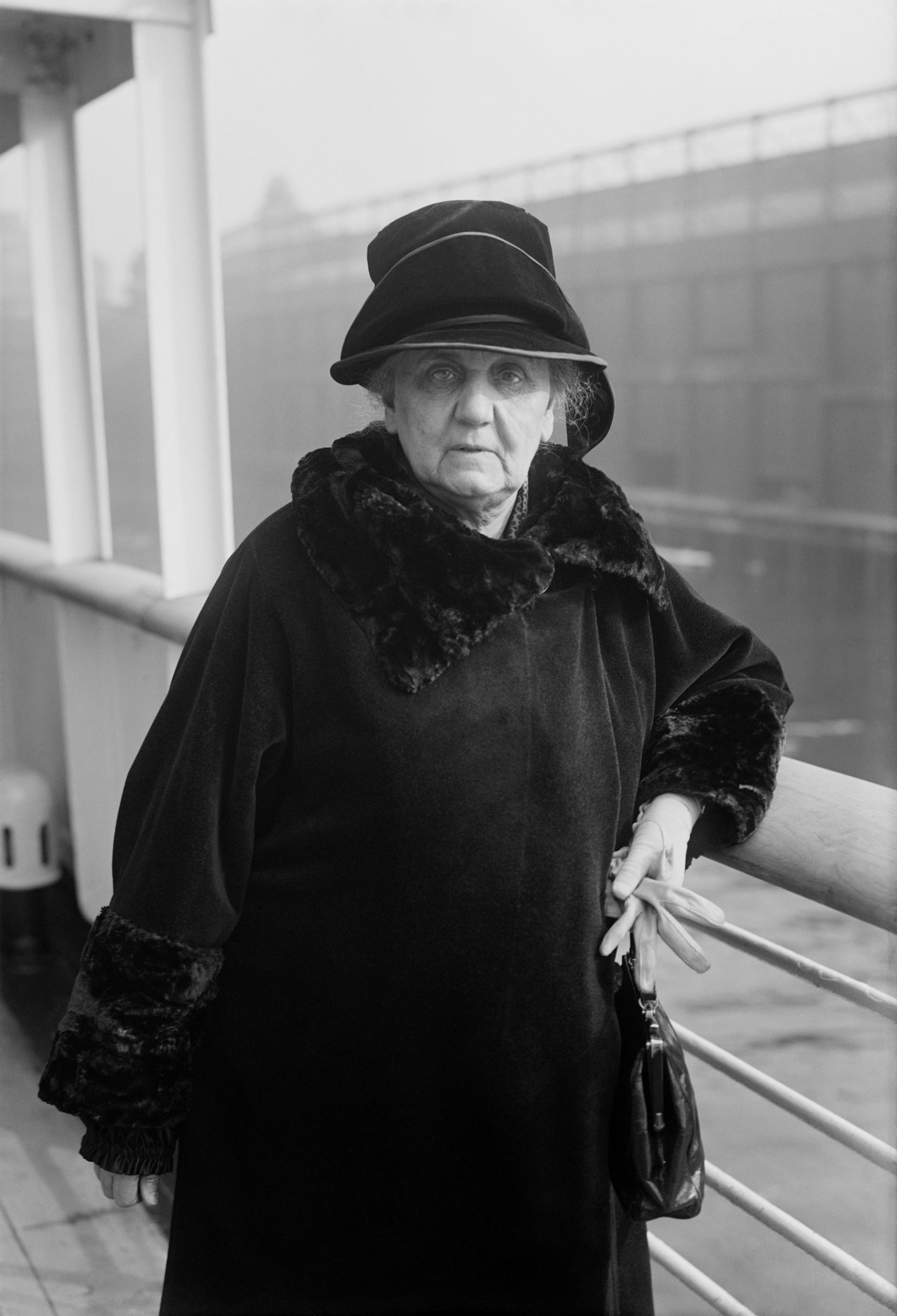
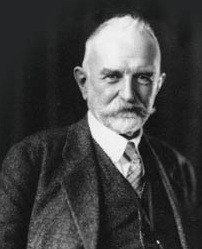
The founder of symbolic interactionism is generally considered to be the American philosopher and sociologist George Herbert Mead (1863-1931) who emerged from a line of thinkers known as ‘pragmatists’ (along with scholars like John Dewey (1859-1952), Charles Peirce (1839-1914) and Jane Addams (1860-1935). Fundamental to pragmatics is the contention that individuals encounter symbols, language, people and ideas in everyday life, which they engage with, reflect on, and think through, that has influence on their actions/ideas. Furthermore, pragmatists consider that humans do have agency in their relationship to surrounds (including the economy contrary to Marx), and can influence the direction of society generally. Jane Addams in particular engaged positively with this idea, arguing for social change through the direct action of people into democratic processes – attempting to combine theory into action. She became, as a result, instrumental in the women’s suffrage movement in the early 1900s. For others like Peirce (cited in Turner et al., 2007, p. 322), pragmatism required interpretations on how people encounter language, symbols and relations that caused them to “self-control”. In any account, the point of this style of thinking is to study on-the-ground impacts, consider that humans can create change, and accept that people are also rational human beings who will interpret according to logic and reason.
Some of the most important contributions of Mead (1934/1972) come in his book Mind, Self and Society in the areas of the mind, symbols and role-taking. Firstly, the mind for Mead (1934/1972) exists only due to the interaction that we have in our everyday lives and within different contexts. He argues that “we must regard mind, then, arising and developing within the social process, within the empirical matrix of social interactions”, where the individual cannot be conceived of as, “in isolation from other individuals” (Mead, 1934/1972, p. 133). In other words, the mind does not exist alone, it comes to being through social relations we have. While the brain of course exists in isolation biologically, the behaviours we learn, experience, interpret and produce meaning through, happen because of our relations with others.
These, however, are importantly not simply language. We arrange our social relations through a range of verbal and non-verbal communication including gestures, symbols, certain words, sounds and the responses of those who are receiving them. Unlike animals who all gesture to one another to display certain emotions (for instance consider a cat growling and hissing to another cat), humans for Mead (1934/1972) are more complex and encode shared understanding of symbols in word and gesture. This can only exist for him based on role-taking. A person receiving the symbolic gesture can understand it only because they are able to place themselves (even unconsciously) in the role of the other person. For example, if a lecturer comes to class and slams his books onto the table, shaking his head and peering at his students with narrowed eyes and a frown, it does not require explaining to the students how he is feeling. This is not an automated response though for the students encoded into their biology. Rather, this exists for Mead (1934/1972) only because we share an understanding culturally of what that gesture means, and students understand the lecturer’s role, and can attribute actions based on that role. Symbolically, how we act and react to others is a form of culture, that exists in the everyday where we share meaning and understanding of each other, even strangers.
Role-taking, and understanding, feeds directly into our understanding of our ‘selves’ or identity for Mead (1934/1972). In particular, there are two aspects of the self that needs to be understood here – firstly the ‘me’ which is your understanding and relation of yourself in different roles (eg. student/teacher above) and secondly ‘I’ which is your own understanding of who you are as a person. This latter part of your self emerges in accordance to the relations you have with other people. This includes the way they respond to your behaviour and what your reactions are to them. For instance, you might come to class and start to behave jokingly in front of other students, causing them to laugh, and eventually come to know you as ‘funny’. This identity that they have is cast upon you, changing their behaviour, but also causing you to perhaps adopt the role of the ‘funny’ person from hereon. Your actions and the positive support of them from the others (such as laughing at your jokes), will only enhance your identity further. For Mead (1934/1972) this is not something you just acquire overnight however. Throughout your life, your self-concept is developed within the initial stages of childhood where you learn roles and notions of the self, and through to later life as a child and teenager where you learn more complex ideas of who you are. This then extends throughout your life as you constantly shape and reshape your identity based on new roles and new responses to behaviour from others.
Mead’s (1934/1972) influence extended to the scholarship of his student Herbert Blumer (1900-1987). Blumer (1969) developed Mead’s work further into a school of thought, symbolic interactionism, constructing methodological and theoretical premises to this form of sociology. There are effectively three of these as follows;
- Humans act/react on the basis of meanings which they give to different objects, events or people. In other words, people do not simply act in some form of biological determinism. We are social creatures, and our actions are not simply automated through some form of unconscious programming (like animals).
- Meaning is constructed or derived from the interaction that individuals have with others. In other words, meaning is not fixed forever, but changes accordingly through action and reaction over time. Norms of behaviour are therefore, never ‘normal’ or fixed, but rather shaped according to the actions and reactions of people in interaction with one another.
- Meanings are understood, and modified, through an interpretive process undertaken by the individual with agency. People do not simply make sense of the world around them through norms created for them, but negotiate these according to different ideas and values. People are indeed creative, and not simply conditioned to act certain ways by society or culture (as Durkheim might contest). We reflect, ponder, engage, reject and question meaning all the time. These actions (as per premise 2) impact how we see the world, and can create social change.
We can simplify this for you with an example. Imagine you are queuing up with your friend to get some food at a cafe. You line up behind others ahead of you until someone walks directly up to the cash register and starts to order food. The other people in the queue get annoyed and whisper to themselves, but no one says anything. Your friend turns to you and says something derogatory about the person who jumped ahead. You nod in agreement. What sorts of symbolic norms are being shared amongst the people in the queue? What sorts of gestures do they have in common in shared understanding? How would you react? Can you think of any other shared interactions like this where the premises of Blumer (1969) can be used to analyse them?

Contrary to mainstream sociology of his day, but also of the past sociologists like Durkheim, Blumer (1969) saw sociology’s main task is to understand that society, culture and the self, are not simply fixed. Rather, through an ongoing process of interaction, interpretation and reflection, these things are constantly in flux. People are always interacting, creating meaning, sharing that meaning, and at times challenging those meanings creating new ideas, values and norms. The self, or your identity, is never completed and is always developing as you are introduced to new roles, new situations and as such new meanings of who you are as a person. We are not simply products of culture, but rather, agents with agency with creative potential – but acting with others in a constantly changing culture.
Perhaps one of the more common names you will hear associated with this school of thought is that of Erving Goffman (1922-1982). Importantly, Goffman (1959/2002) coined the term ‘dramaturgical sociology’ in his now well-cited book The Presentation of Self in Everyday Life, which, to a degree, reflects the great metaphor from Shakespeare ‘all the world is a theatre’. Goffman, like the other symbolic interactionists, focused his work on the deeper underlying meaning that exists in life at the everyday level. While the world is not a theatre in the explicit sense for him, our everyday lives and interactions are far more like a play than what we might admit. As such, your notion of who you are, your identity, emerges from the roles you play in life, and the ‘performances’ which you give in public life (and private perhaps too).
Important for Goffman (1959/2002) is that notion of the role. Like an actor or actress, we all play different parts in the everyday. With those roles come certain norms, expectations, ideals, and traits which, like a performer, require the individual to adopt or adapt in order to ‘look the part’. For instance, as a lecturer at a university, there are certain traits and norms that come with the role. That includes how to dress, act, behave, emotions and even the mannerisms that one uses when teaching. These things have to be done properly, otherwise, the audience (the students) will not believe the authenticity of the lecturer, and perhaps reject them altogether. Think about all the roles you play in everyday life – what sorts of norms, even dress standards, do you think are required to perform them?
Watch this short presentation [1:58] on Goffman’s ‘performed self’ for a brief explainer of his theory.
For Goffman (1959/2002), the action of performing the role, or in other words your identity, is not a one-way communication, as the above video makes clear. Rather, just like being on stage as a performer, your success in convincing people of your performance is reliant on audience participation, and their response to you. Goffman (1959/2002) argues that if the audience does not believe, or does not accept your performance, they will not accept you or be influenced by you (very important in politics), and may even provide negative responses (think of audiences booing for instance). He also argues (1959/2002, p. 17) that the performer themselves needs to be convinced of the “impression of reality” – in other words, you need to be convinced yourself that you are suited to the role. When you and the audience have favourable communication verbally and non-verbally to one another, your identity (in that role) and your sense of self is affirmed. If the communicative act/performance breaks down, then your identity in that role is challenged or maybe even rejected. As an example, let me (the author) share an experience. When I first started lecturing as a casual staff member, I taught a business class. I came from a humanities and social science background where people dressed a little more casually than most. When I entered the class to tutor for the first time in an evening class, I noticed that most of the people were professionals, dressed in office attire, having come from their work. One of the members of the class said to me from the outset, ‘We did not think you were the teacher but a student in the wrong class!’ The comment made me feel like I was not suited to the role – and next week I showed up in office attire!
Goffman (1959/2002) admits that not all the world is a stage though. We do perform our roles mostly publicly or amongst others, following rules, norms and expectations. Metaphorically, this is what Goffman (1959/2002) calls the ‘front stage’. However, Goffman (1959/2002) also refers, to the ‘backstage’ where people can loosen themselves from the roles of everyday life, and adopt different props, clothes, mannerisms and actions that would otherwise contradict their front-stage performances. They are also places where people prepare, away from the audience’s eyes for their roles on the front stage. Simone de Beauvoir (1952/2023) for instance described the different activities that a woman has to go through in order to prepare herself for the front-stage performance of being a ‘woman’. Importantly, the backstage is a place kept hidden from view. It contains both the secrets of the performance, but also, the potential for discrediting information about our public identities, that we seek to keep away from view. Unfortunately, the audience can at times discredit our identities, even when in view.
This might seem ultimately silly to think about, and maybe obvious. However, for someone like Goffman (1959), this playing of roles and the audience response is fundamental to how we live our lives and develop our identities. At times, we also live our identities according to the ideas or expectations that people have of our external traits or characteristics. Our ethnicities, gender, height, weight and so on, can be laden with norms or stereotypes about who we are by other groups/people. Howard Becker (1928-2023) in his work, described this phenomenon as ‘labelling’. Becker (1963) argued that at times, we tend to view how people act or present themselves as deviant. Specifically, “whether a given act is deviant or not depends in part on the nature of the act […] and in part what other people do about it” (Becker, 1963, p. 33). As such, there are no inherently ‘deviant’ people out there (remember symbolic interactionism rejects biological reasoning here), rather the process of labelling someone or some action as ‘deviant’ is founded in the relational. In other words, if a group of people collectively agree that something is deviant (or someone) they will declare it as such. Unfortunately for someone like Becker (1963), if someone is labelled deviant, they might adopt what he calls a deviant identity.
Goffman (1963/2009) takes this further by arguing that through dramaturgical analysis, we can see how the audience will carry with them certain ideas that will stigmatise certain people. For Goffman (1963) there are three general types of stigmas, physical, character and ethnicity or religion. Stigmas work to degrade someone’s identity and sense of self in the interaction that exists between the performer and the audience. A stigma can limit someone’s role, discrediting them immediately in the eyes of the audience, or worse still pre-empting their behaviour through certain degrading ideas. Stigmatisation involves reducing the person to the traits that an audience identifies in them, and as a result, positions them as abnormal, an outsider, and even potentially, below human. Stigma can operate in various ways in our society and interactions with others, from the micro-level to the macro as we have seen throughout history with genocides. For Goffman (1963), it is just as important to recognise what stigmas are, as it is to understand how the stigmatised person responds. For him, some people may try and correct their identities, and overcome stigma. For others, they may adopt the stigma into their personality or sense of self and accentuate their differences. Furthermore, for others, their stigmas might lead to success in certain areas of life, but this only serves to reinforce stereotypes, and the person’s identity.
Symbolic interactionism is a significant attempt in sociology’s history to try and understand identity, and how they are constructed, not through macro cultural concepts (as Durkheim might argue), but rather as an emergent process of interaction. One of the criticisms of this approach is that it focuses too heavily at times on the micro, meaning that we can never say anything of substance to broader society (Alexander & Smith, 2018). Furthermore, and this is potentially a criticism of sociology, there is a heavy emphasis on identity, action and behaviour, being constituted through social interaction. This tends to deny other important contributors, including our genetic, biological, evolutionary, and neuroscience makeup (Kivisto, 2011). Symbolic interactionists dismiss these, and in some respects deny a more holistic view of human interaction. We know for instance, that certain responses we have to different social stimuli can be entirely automatic, according to neurological changes that are programmed into us. For instance, flight, fight or freeze responses to overly stressful or threatening situations are defence mechanisms developed via evolution (Donahue, 2020). We also know that emotions are deeply important to decision-making, and not all our reflections on who we are come from places of logic or reason (Stets, 2005). Regardless of these critiques, symbolic interactionism is a unique sociological approach to understanding identity in the contemporary world.
In Summary
The key takeaways from this chapter are as follows:
- Culture and identity are hard to define as several theorists have defined them in different capacities.
- Durkheim contested that culture in a secular society could still have elements of the sacred and profane to increase feelings of collective togetherness.
- Weber argued that rationalisation, and disenchantment, were having a major impact on cultural life, standardising and rationalising all.
- Simmel argued that modern culture had grown too large, overwhelming the individual, and disabling an ability to cultivate identities.
- The symbolic interactionists argue that our roles in everyday life define much of who we are as identities, and we reflect on these through our relations with others.
- Goffman’s presentation of the self arguments, further this by arguing that we present ourselves in our roles, but need the audience to be convinced of our performance.
As mentioned in the introduction to this chapter, there is too much to cover for one chapter on culture and identity. Below is a list of recommended resources to assist in developing knowledge of these two important concepts.
Recommended Resources
Alexander, J. C., Jacobs, R., & Smith, P. (2010). The Oxford handbook of cultural sociology. Oxford University Press.Blackshaw, T. (2005). Zygmunt Bauman. Routledge.
Blumer, H. (1986). Symbolic interactionism: Perspective and method. University of California Press.
Elliott, A. (2021). Contemporary social theory: An introduction. Routledge.
Fardon, R. (2002). Mary Douglas: An intellectual biography. Routledge.
Giddens, A. (2016). Modernity and self-identity. In W. Longhofer, D. Winchester & A. Baiocchi (Eds), Social theory re-wired (2nd ed., pp. 512-521). Routledge.
Harrington, A. (2005). Modern social theory. Oxford University Press.
Inglis, D., & Almila, A. M. (Eds.). (2016). The Sage handbook of cultural sociology. Sage.
Six, P. (2018). The institutional dynamics of culture, volumes I and II: The new Durkheimians. Routledge.
Sørensen, M., & Christiansen, A. (2012). Ulrich Beck: An introduction to the theory of second modernity and the risk society. Routledge.
Spillman, L. (2020). What is cultural sociology? John Wiley & Sons.
Spykman, N. J. (2017). The social theory of Georg Simmel. Routledge.
Turner, B. S. (1996). For Weber: Essays on the sociology of fate. Sage.
References
Adam, B. (2009). Cultural future matters: An exploration in the spirit of Max Weber’s methodological writings. Time & Society, 18(1), 7-25.
Adorno, T. W., & Horkheimer, M. (1997). Dialectic of enlightenment. Verso.
Alexander, J. C., & Smith, P. (2018). The Strong Program in cultural sociology: Meaning first. In L. Grindstaff, M-C. M. Lo & J. R. Hall (Eds.), Routledge handbook of cultural sociology (2nd ed., pp. 13-22). Routledge.
Bartmanski, D., & Woodward, I. (2018). Vinyl record: A cultural icon. Consumption Markets & Culture, 21(2), 171-177.
Baudrillard, J. (1983). Simulations. Semiotext(e).
Bauman, Z. (2005). Liquid life. Polity Press.
Beck, U. (1992). Risk society: Towards a new modernity. Sage.
Becker, H. S. (1963). Outsiders. Free Press.
Bennett, J. (2001). The enchantment of modern life: Attachments, crossings, and ethics. Princeton University Press.
Blumer, H. (1969). Symbolic interactionism: Perspective and method. Prentice-Hall.
De Beauvoir, S. (2023). The second sex. In W. Longhofer, D. Winchester & A. Baiocchi (Eds), Social theory re-wired (2nd ed., pp. 346-354). Routledge. (Original work published 1952)
Donahue, J. J. (2020). Fight-Flight-Freeze system. In V. Zeigler-Hill & T. K. Shackelford (Eds.), Encyclopedia of personality and individual differences (pp. 1590-1595). Springer International Publishing.
Douglas, M. (2003). Purity and danger: An analysis of concepts of pollution and taboo. Routledge. (Original work published in 1966)
Durkheim, E. (2013). Emile Durkheim: The division of labour in society (2nd ed.). Palgrave Macmillan Basingstoke. (Original work published 1912)
Durkheim, E (1995). The elementary forms of religious life. Free Press New York. (Original published 1912)
Foucault, M. (1975). Discipline and punish. Gallimard.
Geertz, C. (1973). The interpretation of cultures. Basic Books.
Giddens, A. (1991). Modernity and self-identity: Self and society in the late modern age. Polity.
Gibson, M. (2008). Objects of the dead: Mourning and memory in everyday life. Melbourne University Publishing.
Goffman, E. (2002). The presentation of self in everyday life. Penguin. (Original work published 1959)
Goffman, E. (2009). Stigma: Notes on the management of spoiled identity. Simon and Schuster. (Original work published 1963)
Hertz, R. (2013). Death and the right hand. Routledge. (Original work published 1909)
Kivisto, P. (2011). Illuminating social life: Classical and contemporary theory revisited. Pine Forge Press.
Mauss, M. (1990). The gift: The form and reason for exchange in archaic societies. Routledge. (Original work published 1925)
Mauss, M. (2013). Seasonal variations of the Eskimo: A study in social morphology. Routledge. (Original work published 1906)
Mead, G. H. (1972). Mind, self, and society from the standpoint of a social behaviorist. University of Chicago Press. (Original work published 1934)
Osbaldiston, N., & Petray, T. (2011). The role of horror and dread in the sacred experience. Tourist Studies, 11(2), 175-190.
Pyyhtinen, O. (2018). The Simmelian legacy. Bloomsbury Publishing.
Riley, A. T. (2010). Godless intellectuals?: The intellectual pursuit of the sacred reinvented. Berghahn Books.
Ritzer, G. (2010). Enchanting a disenchanted world: Continuity and change in the cathedrals of consumption. Pine Forge Press.
Ritzer, G. (2011). The McDonaldization of society 6. Pine Forge Press.
Simmel, G. (1997). Simmel on culture: Selected writings. Sage.
Simmel, G. (2010). The view of life: Four metaphysical essays with journal aphorisms. University of Chicago Press.
Simmel, G. (2011). The philosophy of money. Routledge. (Original work published 1900)
Smith, P. (1999). The elementary forms of place and their transformations: A Durkheimian model. Qualitative Sociology, 22(1), 13-36. https://doi.org/10.1023/A:1022179131684
Smith, P. (2008). Punishment and culture. University of Chicago Press.
Spencer, B., & Gillen, F. J. (2010). Native tribes of central Australia. Cambridge University Press. (Original work published 1899)
Stets, J. E. (2005). Examining emotions in identity theory. Social Psychology Quarterly, 68(1), 39-56.
Swidler, A. (1986). Culture in action: Symbols and strategies. American Sociological Review, 51(2), 273-286. https://doi.org/10.2307/2095521
Turner, J. H., Beeghley, L., & Powers, C. H. 2007. The emergence of sociological theory (6th ed.). Thomson Higher Education.
Weber, M. (2002). The Protestant ethic and the spirit of capitalism and other writings. Penguin Publishing. (Original work published 1905)
Weber, M. (2012). Science as a profession and vocation. In H. H. Bruun & S. Whimster (Eds.), Max Weber: Collected methodological writings, (pp. 335–353). Routledge. https://doi.org/10.4324/9780203804698
West, B. (2022). Finding Gallipoli: Battlefield remembrance and the movement of Australian and Turkish history. Springer Nature.
Woodward, I. (2007). Understanding material culture. Sage.
Media Attributions
- Close up photo of colour pencils
- Cover of the French edition of the Division of Labor in Society
- Émile Durkheim
- Picture2
- Shopping center Melbourne, Australia
- Georg Simmel
- Flinders Street Station
- Jane_Addams_-_Bain_News_Service
- George_Herbert_Mead
- michal-parzuchowski-1O77vgBVkXQ-unsplash
- miguel-henriques–8atMWER8bI-unsplash
Refers to objects, people, ideas or other things that are considered above the everyday and which need to be protected at all costs. Emile Durkeim argues that sacred things represent group identity - such as a cross at a Christian church.
The oppositive of the sacred. For Emile Durkheim, the profane is the everyday world which requires separation from sacred things.
Relates to Baudrillard's theory of modern life – where copies of original things, become the 'real' for contemporary culture.
pertains to the culture activities and artifacts that are usually aligned with the upper middle to upper classes. For instance, opera music or polo.
pertains to the cultural activities and artifacts that are usually aligned with lower middle and lower classes. For instance, football or rugby league.
Refers to the sociological and psychological make-up of who we are as people – both in how we identify ourselves, and how others identify us through different characteristics and roles.
The idea that people take on information, process it through their own logic, reason and emotions, and make decisions accordingly. Reflexivity denotes a turn from premodern societies, where choices were limited, to one of late modernity where choices are abundant in life, but also require deep thinking and reflecting, and weighing up risks with benefits.
A school of thought, based on the scholarship of Emile Durkheim, but operationalised by Talcott Parsons that aims to create theory/knowledge on how societies can best function as a whole with different roles.
A term from Emile Durkheim's work that reflects the broad norms and values that bind together a culture which enables but also constrains individual social action.
Refers to the time period where Europeans in particular began to dramatically and quickly change the organisation of society, culture and economy. This included the rise of the nation-state, rationalism, science, organised labour and the intensification of urbanisation and growth of cities. Sociological figures refer to modernity demarcate it from pre-modern times where societies were arranged far differently.
Denotes the smaller community-based society which has strong social ties, less diverse roles and a stronger relationship to community organisations like religion.
Denotes the broader societal shift to societies that are large, have diverse roles and occupations, less social integration and less commitment to community institutions such as religion.
Refers to the disconnection of the individual to the collective, and into a more isolated, individualised lifestyle.
An economic system that dominates the world today in which society's economic activity is organised around trade for profit and private property.
Refers to the theory from Max Weber that the social and cultural worlds we live in are increasingly becoming rationalised – in other words, technically or scientifically explained. Weber also argued that this would increase until there were very few things left that could be explained without science (such as religion).
An approach within social science theories that argues the social world cannot be understood through natural sciences. Rather, society is messy and complex and research can only obtain an understanding of how people interpret or perceive the world around them.
The term used to denote the gradual adoption of scientific and other 'rational' means or knowledge to understand social life. In other words, the removal of myths and religion as the main driver for understanding our worlds.
A period of time in Europe where human reasoning was privileged in the pursuit of truth (for instance science) over other approaches (for instance religion/mythology)
The key goals of this chapter are to explain that:
- sex, gender, and sexuality are different concepts that sometimes overlap but they are all essential to understand as socially constructed
- the social construction of gender is shaped by families (and schools, media, and more), and social understandings of gender shape how families are structured
- society has normative beliefs that push people towards certain expressions of gender, sexuality, and family
- although they are socially constructed, categories of sex, gender, and sexuality serve as important foundations for inequalities in Aotearoa New Zealand and Australia (and beyond)
- there are many theoretical perspectives a sociologist may use to critically analyse gender, sexuality, and family.
Overview
In Tokyo in August 2021, an Olympic athlete from Aotearoa New Zealand made history – not for the weight-lifting records she broke (she did not advance to the final in her competition). Laurel Hubbard is an openly transgender athlete who was given permission to compete in the Women’s Weightlifting competition at the Tokyo Olympics. While she isn’t the first openly trans athlete to make headlines, her participation in the event attracted a lot of attention and controversy (Scovel et al., 2022).
The International Olympic Committee (IOC) updated their approach in 2015, paving the way for Hubbard and others to participate. The IOC framework aims to balance inclusion and non-discrimination with fairness. However, the majority of sporting competitions, especially at elite levels, are organised along binary, gendered lines. According to their 2021 framework, the IOC encourages athletes to compete in the category (men’s or women’s) that best aligns with their 'self-determined gender identity', so long as they do not have a disproportionate advantage or present a safety risk to other athletes (IOC, 2021).
Examples like Hubbard’s highlight the complex nature of gender identity, how it intersects with biology, and the way these issues are highly politicised in contemporary society (Burbery, 2020). Trans participation in sport is one topic among many that attracts heated debate in the mainstream media.
In this chapter, we will discuss sex and gender, and we will also discuss sexuality and families. These are different areas of study but they overlap considerably, so we discuss them here together so you can think about how they influence one another.
Definitions
Sex and Gender

When filling out a document such as a job application or school registration form you are often asked to provide your name, address, phone number, birth date, and sex or gender. But have you ever been asked to provide your sex and your gender? Most people think that sex and gender are interchangeable terms. As another example, we can look at 'gender reveal' parties held for unborn babies. These are gatherings where guests – and often the future parents themselves – are surprised in some way with pink or blue to indicate whether they will have a girl or a boy.
However, sociologists and most other social scientists view sex and gender as conceptually distinct. Sex refers to physiological characteristics that have been associated with maleness or femaleness. Gender, however, refers to cultural and social understandings of masculinity and femininity. These two do not always align.

Australian philosopher Cordelia Fine (2017) writes about the relationship between biology and sex and provides examples from numerous animal species that complicate our understandings of the nature vs. nurture debate. Her discussion of biological sex is what we will focus on here. The physical characteristics most commonly used to determine sex are the genitals – when a baby is born (or even before), we look for a penis or a vulva. However, most of the time we move through the world without anyone seeing our genitals! So what characteristics do people use to assume our sex?
🧠 Learn More
Cordelia Fine identifies three Gs that form our understandings of biological sex – genitals, gonads (or reproductive organs), and genetics (XY chromosomes for males, XX chromosomes for females). However, what happens if these don’t fit neatly into categories? It is possible to have a combination of these three Gs that don’t all align with one sex. It is also possible to fall outside of the binary altogether.
Intersex people are a very diverse group whose innate sex characteristics (one or more of their three Gs) differ from medical norms for male or female bodies. It is hard to accurately measure how many people are intersex, but Intersex Aotearoa estimates 2.3% of the population has some intersex variation, and Intersex Human Rights Australia estimates are around 1.7% of the population.
In general, people make assumptions about who we are based on our gender expression. This includes some physical characteristics, like facial hair, but a lot of this is also the result of choices we make about our appearance, like our hairstyle and clothing. Gender identity is how we feel – like a man or like a woman, and our gender expression is whether we 'perform' in masculine or feminine ways. Increasingly, people are identifying as non-binary or agender, meaning they do not identify predominantly with either masculinity or femininity.
Contrary to the common understandings, gender is not determined by biology in any simple way. The experience of transgender people demonstrates that a person’s biological sex does not always correspond with their gender. In contrast, the term cisgender refers to people whose gender aligns with the sex assigned to them at birth. Therefore, the terms sex and gender are not interchangeable.
Gender roles are society’s concepts of how men and women are expected to act and how they should behave. These roles are based on norms, or standards, created by society. In Aotearoa New Zealand and Australia, for the most part, masculine roles are associated with strength, aggression, and dominance, while feminine roles are associated with passivity, nurturing, and subordination.

Role learning starts with socialisation at birth (see the culture, socialisation chapter). One way children learn gender roles is through play. Parents typically supply boys with trucks, toy guns, and superhero paraphernalia, which are active toys that promote motor skills, aggression, and solitary play. Girls are often given dolls and dress-up apparel that foster nurturing, social proximity, and role play.
The drive to adhere to masculine and feminine gender roles continues later in life. Men tend to outnumber women in professions such as law enforcement, the military, and politics. Women tend to outnumber men in care-related occupations such as childcare, health care, and social work. These occupational roles are examples of typical gendered behaviour, derived from our culture’s traditions.
Sexuality
Sexuality refers to a person’s capacity for sexual feelings and their emotional and sexual attraction preferences. Generally, we think about sexuality as determined by what gender someone is attracted to. However, it may not surprise you to hear that this way of understanding sexuality is too simplistic! Sexuality also refers to someone’s sexual identity, the kinds of experiences they seek out, their desires, their drive for physical pleasure, their approach to achieving physical pleasure, and more. So while the spectrum of sexuality certainly includes heterosexuality, homosexuality, and bisexuality, it includes a whole range of other identities, too.
🔍 Look Closer: Spectrums of Sexuality and Relationships
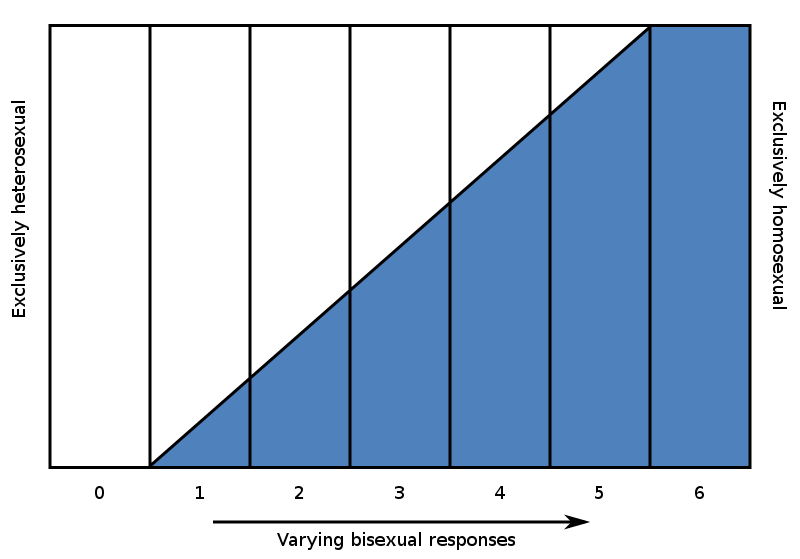
Alfred Kinsey was among the first to conceptualise sexuality as a continuum rather than a strict dichotomy of gay or straight. To classify this continuum of sexuality, Kinsey created a seven-point rating scale that ranges from exclusively heterosexual to exclusively homosexual. In his 1948 work Sexual Behavior in the Human Male, Kinsey writes, “Males do not represent two discrete populations, heterosexual and homosexual. The world is not to be divided into sheep and goats … The living world is a continuum in each and every one of its aspects” (Kinsey et al., 1948, p. 639).
Later scholarship by Eve Kosofsky Sedgwick expanded on Kinsey’s notions. She coined the term 'homosocial' to oppose 'homosexual', describing nonsexual same-sex relations. Sedgwick recognised that in North American culture, men are subject to a clear divide between the two sides of this continuum, whereas women enjoy more fluidity. This can be illustrated by the way women in Western societies can express homosocial feelings (nonsexual regard for people of the same sex) through hugging, hand-holding, and physical closeness. In contrast, men’s behaviour is subject to strong social sanction if it veers into homosocial territory because of societal homophobia (Sedgwick, 1985).
It can feel like there is a mind-boggling array of terms relating to sexuality. The article, 47 terms that describe sexual attraction, behavior, and orientation, for example, has almost 50. Consider the value of labels such as those defined in the link. Is it beneficial to find a label that explains your experiences, or do labels constrain our understandings of ourselves as fluid and complex beings?
In addition to sexuality being related to which gender one is attracted to, it is tied up with gender in other ways, too. For example, there are different social norms and expectations of men’s sexuality as compared to women’s. There are stereotypes that men have higher sex drives than women, and this can be used to explain things like infidelity and sometimes even sexual violence. It also leads to significant differences in sexual pleasure between women and men (Mahar et al., 2020). One explanation might be that female bodies are less capable of achieving sexual pleasure – however, the statistics for women in relationships with other women suggest otherwise.
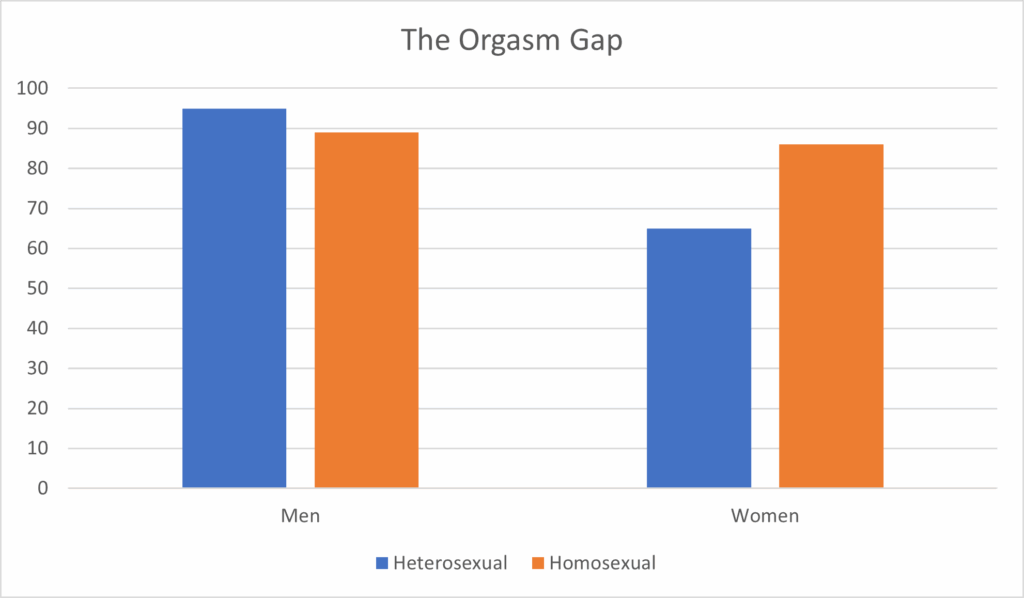
You may be familiar with some variations of the acronym LGBTQIA+. This is an umbrella acronym that includes a range of sexualities and gender identities – Lesbian, Gay, Bisexual, Transgender, Queer, Intersex, Asexual/Aromantic, and the plus sign indicates there are many other labels not directly included in the acronym, but included in the spirit of the grouping.
Family

Families are often considered the most basic social unit upon which society is built. The question of what constitutes a family is a prime area of debate in family sociology, as well as in politics and religion. Social conservatives tend to define the family in terms of a 'traditional' nuclear family structure with each family member filling a certain role (like father, mother, or child). Sociologists, on the other hand, tend to define family more in terms of the way members relate to one another. Here, we will define family as a socially recognised group joined by bonds including blood relations, marriage, or adoption, that forms an emotional connection and serves as an economic unit of society. Much recent attention has also been paid to families of choice, which refers to groupings that may not cohabitate, and may not have legal or blood relations, but do serve as essential emotional support networks.
Based on Georg Simmel’s (1908/1950) distinction between the form and content of social interaction, we can analyse the family as a social form that comes into existence around five different contents or interests: sexual activity, economic cooperation, reproduction, socialisation of children, and emotional support. The types of family forms in which all or some of these contents are expressed are diverse: nuclear families, polyamorous families, extended families, same-sex parent families, single-parent families, blended families, zero-child families, etc.
The forms that families take are determined by cultural traditions, social structures, economic pressures, and historical transformations. They also are subject to intense moral and political debate about the definition of the family, the 'decline of the family', or the policy options to best support the well-being of children. In these debates, sociology demonstrates its practical side as a discipline that is capable of providing the factual knowledge needed to make evidence-based decisions on political and moral issues concerning the family.
The 'traditional nuclear family' is the product of white Western society, and it rose to prominence following WWII (Gilding, 2001). Although it only lasted as the predominant family form for around two decades – declining again when divorce became more accessible and women gained increased rights and freedoms – it maintains a powerful hold on our ideas of what families 'should' look like.
While the nature of families may change over time and in different social contexts, the importance of belonging to a family does not. Humans are social animals. Being intimately bonded to others is a shared feature of all human societies.
Socialisation
In the identity, self and culture chapter, we discussed the concept of socialisation. We discuss it again here because gender and sexuality are two ways in which we can clearly see the effects of socialisation – and families are a key agent of socialisation (along with education, peer groups, media, and other secondary agents). Agents of socialisation create and maintain normative expectations for behaviour based on gender and sexuality. Socialisation occurs repeatedly over time and becomes seen as natural and innate rather than a product of social construction.
Gender socialisation within families occurs in a number of ways. It includes the gendered roles that parents play, which children absorb. Many households are characterised by gender roles, with recent research in Australia suggesting over 75% of heterosexual couples divide household labour on traditional gender roles (Siminski & Yetsenga, 2022). Children observe this division of labour and may consider it natural that women do the bulk of unpaid labour within the home.
Gender socialisation also includes the ways that boys and girls are spoken to and about, the rules and expectations of their behaviour, and even the chores they are given. Even when parents set gender equality as a goal, there may be underlying indications of inequality. For example, when dividing up household chores, boys may be asked to take out the garbage or perform other tasks that require strength or toughness, while girls may be asked to fold laundry or perform duties that require neatness and care. It has been found that fathers are firmer in their expectations for gender conformity than are mothers, and their expectations are stronger for sons than they are for daughters (Kimmel, 2000). This is true in many types of activities, including preference of toys, play styles, discipline, chores, and personal achievements. As a result, boys tend to be particularly attuned to their father’s disapproval when engaging in an activity that might be considered feminine, like dancing or singing (Coltrane & Adams, 2008). It should be noted that parental socialisation and normative expectations vary along lines of social class, race, and ethnicity. Research in the United States has shown that African American families, for instance, are more likely than white families to model an egalitarian role structure for their children (Staples & Boulin Johnson, 2004).
In schools, boys are permitted a greater degree of freedom regarding rule-breaking or minor acts of deviance, whereas girls are expected to follow rules carefully and to adopt an obedient posture (Ready, 2001). Schools reinforce the polarisation of gender roles and the age-old 'battle of the sexes' by positioning girls and boys in competitive arrangements.
Mass media serves as another significant agent of gender socialisation. Research of children’s movies indicates that of the 101 top-grossing G-rated movies released between 1990 and 2005, three out of four characters were male. Out of those 101 movies, only seven were near being gender balanced, with a character ratio of less than 1.5 males per 1 female (Smith, 2008). More recently, the Geena Davis Institute releases research annually on diversity and inclusion in media. Their report includes popular programming (ten most popular shows amongst children ages 2-11) and current programming (new shows, and existing shows with new seasons) based on US statistics in 2021. The findings are an improvement on Smith's (2008) findings, with 61.6% of lead characters being male-identified, although there are differences between the two data sets (Meyer & Conroy, 2022). However, this improvement is still not representative of gender parity.
Social Constructions of Gender and Sexuality
Gender, sexuality, and norms around family structure seem natural and innate. Here we will focus on sex and gender to explore the idea of social construction.
In our societies, the dominant gender schema is an ideology that serves to perpetuate inequalities in power and status. This schema states that: a) sex is a biological characteristic that produces only two options, male or female, and b) gender is a social or psychological characteristic that manifests or expresses biological sex. Again, only two options exist, masculine or feminine.
For many people this is natural. It goes without saying. However, if one does not fit within the dominant gender schema, then the naturalness of one’s gender identity is thrown into question. This occurs, first of all, by the actions of external authorities and experts who define those who do not fit as either mistakes of nature or as products of failed socialisation and individual psychopathology. Gender identity is also thrown into question by the actions of peers and family who respond with concern or censure when a girl is not feminine enough or a boy is not masculine enough. Moreover, the ones who do not fit also have questions. They may begin to wonder why the norms of society do not reflect their sense of self, and thus begin to feel at odds with the world.
As the capacity to differentiate between the genders is the basis of patriarchal relations of power that have existed for 6,000 years, the dominant gender schema is one of the fundamental organising principles that maintains the dominant societal order. Nevertheless, it is only a schema: a cultural distinction that is imposed upon the diversity of the world. Anne Fausto-Sterling (2000) argues that a body’s sex is too complex to fit within the obligatory dual sex system, and ultimately, the decision to label someone male or female is a social decision.

Cordelia Fine’s (2017) research, which we introduced above, finds that there is greater variation within the categories of male and female than there is between them. Some animal species differ greatly between the sexes, but humans are not one of them. Further, Fine shows us that it can be almost impossible to differentiate between innate biological drivers, socialisation and norms that influence how people behave. Rather, she points out that the collection of characteristics we have defined as male versus female are themselves social constructions. This is similar to our discussion, in the chapter race, ethnicity, and Indigeneity – actual physical differences are given social meaning beyond their physical effect, and society builds hierarchies around them.
When people perform tasks or possess characteristics based on the gender role assigned to them, they are said to be doing gender (West & Zimmerman, 1987). Whether we are expressing our masculinity or femininity, West and Zimmerman argue, we are always 'doing gender'. Thus, gender is something we do or perform, not something we are. When the performance matches social expectations, it is unremarkable but, as with sex, is considered natural and normal. However, their work argues that there are no biological foundations for gender differences and these roles are socially constructed. As West and Zimmerman follow Goffman’s (1959) approach to dramaturgy, they focus on social interactions and suggest that the nature of the (gender) role that we play may change depending on which setting we are in.
Gender as a performance is most overt when we think about drag – the exaggerated performance of gender roles, featuring caricature-like depictions of femininity or (less often) masculinity. But West and Zimmerman, along with other theorists like Judith Butler (2004), suggest that all gender is a performance and drag merely makes visible the performative nature. For an example, watch the video below [3:46].
The signs and characteristics of gender vary greatly between different societies. Anthropologist Margaret Mead’s cross-cultural research in New Guinea, in the 1930s, was ground-breaking in its demonstration that cultures differ markedly in the ways that they perceive masculinity and femininity (Mead, 1935). Unlike the qualities that defined masculinity and femininity in North America at the time, she saw both genders among the Arapesh as sensitive, gentle, cooperative, and passive, whereas among the Mundugumor both genders were assertive, violent, jealous, and aggressive. Among the Tchambuli, she described male and female temperaments as the opposite of those observed in North America. The women appeared assertive, domineering, emotionally inexpressive, and managerial, while the men appeared emotionally dependent, fragile, and less responsible.
The dichotomous view of gender (the notion that one is either male or female) is specific to certain cultures and is not universal. In some cultures, gender is viewed as fluid. Some First Nations groups in North America use the term berdache or two-spirit person to refer to individuals who occasionally or permanently dressed and lived as the opposite gender (Jacobs et al., 1997). Samoan culture accepts what they refer to as a 'third gender'. Fa’afafine, which translates as 'the way of the woman', is a term used to describe individuals who are born biologically male but embody both masculine and feminine traits. Fa’afafines are considered an important part of Samoan culture (Manoa et al., 2019).
🧠 Learn More
First Nations people around the world have different understandings of gender and sexuality than their colonisers, though in some cases these understandings have been suppressed by the colonisation process. You can read more about traditional transgender identities in Maori and Pasifika societies. In Australia, non-binary gender identities include Sistergirls and Brotherboys.
Normativity
Part of the power dynamics sociologists investigate in studies of gender, sexuality, and families has to do with so-called normality, and who determines what is normal or not. What is considered 'normal' in terms of sexual behaviour is based on the mores and values of the society. Societies that value monogamy, for example, would likely oppose extramarital sex. Individuals are socialised to sexual attitudes by their family, education system, peers, media, and religion.
These norms determine the degree of ease in which we can live within our own bodies and assume gender and sexual identities. Having a gender or sexual identity is only experienced as normal or natural to the degree that one fits within the dominant gender schema — the ideological framework that states that there are only two possible sexes, male and female, and two possible genders, masculine and feminine. Sexuality is a component of the dominant gender schema in as far as — in heteronormative society — to be a man is to be attracted to women and vice versa. The dominant gender schema therefore provides the basis for the ways inequalities in power and status are distributed according to the degree that individuals conform to its narrow categories.
In heteronormative societies like ours, we assume heterosexuality as the normal and natural mode of being. This heteronormativity means that people who identify as LGBTQIA+ may feel the need to ‘come out’ in a way that heterosexual people do not. Although the idea of coming out as heterosexual, or as a masculine man or a feminine woman, might seem absurd, this absurdity is grounded in the norms of heteronormative society that are so deeply entrenched as to make them appear natural. The social processes of acquiring a gender and sexual identity, or of 'having' a gender or a sexuality, are essentially the same, yet the degree to which society accepts the resulting identities is what differs.
🔍 Look Closer: The History of Homosexuality: Making Up People?
Sociologists often confront a legacy of entrenched beliefs concerning innate biological disposition, or the individual psychopathology of persons who are considered abnormal. The sexual or gender 'deviant' is a primary example. However, as Ian Hacking (2006) observes, even when these beliefs about kinds of persons are products of objective scientific classification, the institutional context of science and expert knowledge is not independent of societal norms, beliefs, and practices. The process of classifying kinds of people is a social process that Hacking calls 'making up people' and Howard Becker (1963) calls 'labelling'.
19th century definitions of homosexuality defined a kind of person: the sexual 'invert'. This definition was 'scientific', but in no way independent of the cultural norms and prejudices of the times. The idea that homosexuality was characterised by an internal, deviant 'inversion' of sexual instincts depended on the new scientific disciplines of biology and psychiatry (Foucault, 1980). Homosexuality as deviance was defined first by the idea that heterosexuality was biologically natural (and therefore 'normal') and second by the idea that, psychologically, sexual preference defined every aspect of the personality. Within the emerging field of psychiatry, it was possible to speak of an inverted personality because a lesbian woman who did not play the 'proper' passive sexual role of her gender was masculine. A gay man who did not play his 'proper' active sexual role was effeminate. After centuries during which an individual’s sexual preference was largely a matter of public indifference, in the 19th century, the problem of sexuality suddenly emerged as a biological, social, psychological, and moral concern.
The new definitions of homosexuality and sexual inversion led to a series of social anxieties that ranged from a threat to the propagation of the human species, to the perceived need to 'correct' sexual deviation through psychiatric and medical treatments. The powerful normative constraints that emerged based largely on the 19th century scientific distinction between natural and unnatural forms of sexuality led to the legacy of closeted sexuality and homophobic violence that remains to this day. Nevertheless, they depend on the concept of the homosexual as a specific kind of person.
As Hacking (2006) points out, the category of classification, or the label that defines different kinds of people, actually influences their behaviour and self-understanding. It is a 'self-fulfilling prophecy'. They begin to experience the world and live in society in a different manner than they did previously. Important contemporary work by LGBTQIA+ scholars focuses on rejecting such classifications, and the normative expectations that only certain genders, sexualities, and family types can be considered worthy of respect and attention in society (Clark, 2015; Newman, 2019; Sullivan, 2018).
In sociological terms, something can be common – experienced by a majority of people, for example. This is often called 'normal', but normativity is when there are expectations and hierarchies attached to that thing. Heterosexuality may be common, but it is normative when our social structures are built as if everyone is and should be heterosexual. The same is true for cisgender identities, and for traditional nuclear families.
Inequalities
Although gender may be socially constructed, normative gender expectations mean that inequalities emerge that have real impacts on people. Gender stereotypes form the basis of sexism. Sexism refers to prejudiced beliefs that value one sex over another. Unequal treatment of women continues to pervade social life, at both the micro- and macro-levels. Many sociologists focus on discrimination that is built into the social structure; this type of discrimination is known as institutional discrimination (Pincus, 2000).
The organisation of society is profoundly gendered, meaning that the 'natural' distinction between men and women, and the attribution of different qualities to each, underlies institutional structures from the family, to the occupational structure, to the division between public and private, to access to power and beyond. Patriarchy is the set of institutional structures (like property rights, access to positions of power, and relationship to sources of income) which are based on the belief that men and women are dichotomous and unequal categories.
How does the 'naturalness' of the distinction between men and women get established? How does it serve to organise everyday life?
The phrase 'boys will be boys' is often used to justify behaviour such as pushing, shoving, or other forms of aggression from young boys. The phrase implies that such behaviour is unchangeable and something that is part of a boy’s nature. Aggressive behaviour, when it does not inflict significant harm, is often accepted from boys and men because it is congruent with the cultural script for masculinity. The 'script' written by society is in some ways similar to a script written by a playwright. Just as a playwright expects actors to adhere to a prescribed script, society expects women and men to behave according to the expectations of their respective gender roles. Scripts are generally learned through socialisation, which teaches people to behave according to social norms.
How do the distinctions between men and women, and the social attribution of different qualities to each, serve to organise our institutions (the family, occupational structure, and the public/private divide, etc.)? How do these distinctions organise differential access to rewards, privileges, and power? In society, how and why are women not treated as the equals of men?
Stratification refers to a system in which groups of people experience unequal access to basic, yet highly valuable, social resources. According to George Murdock’s classic work, Outline of World Cultures (1954), all societies classify work by gender. While the phenomenon of assigning work by gender is universal, its specifics are not. The same task is not assigned to either men or women worldwide. But in Murdock’s examination of the division of labour among 324 societies around the world, in nearly all cases the jobs assigned to men were given greater prestige (Murdock & White, 1969). Even if the job types were very similar and the differences slight, men’s work was still considered more vital.
Our societies in Aotearoa New Zealand and Australia are also characterised by gender stratification. Evidence of gender stratification is especially obvious within the economic realm. In Canada, women’s experience with wage labour includes unequal treatment in comparison to men in many respects:
- Women do more unpaid labour in the household — meal preparation and clean-up, childcare, elderly care, household management, and shopping — even if they have a job outside the home (Australian Bureau of Statistics [ABS], 2022; Ministry for Women, 2019). This double duty keeps working women in a subordinate role in the family structure and prevents them from achieving the salaries of men in the paid workforce (Hochschild & Machung, 1989).
- Women’s participation in paid work has increased. In Australia, women made up just 30% of the paid workforce in 1966 but about half the paid workforce in 2020 (ABS, 2021). In Aotearoa New Zealand, about 42% of paid workers in 1986 were women, compared to about 48% in 2019 (Stats NZ, 2019). However, occupational gender segregation means that many women-dominated industries are lower-paying and lower-status than industries dominated by men. In all industries, men dominate in leadership roles (Workplace Gender and Equality Agency [WGEA], 2019).
- Gender pay gaps persist, even when comparing full-time salaries – in Australia, there was a 13.3% difference in average men’s salaries versus average women’s salaries (WGEA, 2023). In Aotearoa New Zealand, men earn 10% more on average than women do (Employment New Zealand, 2023).
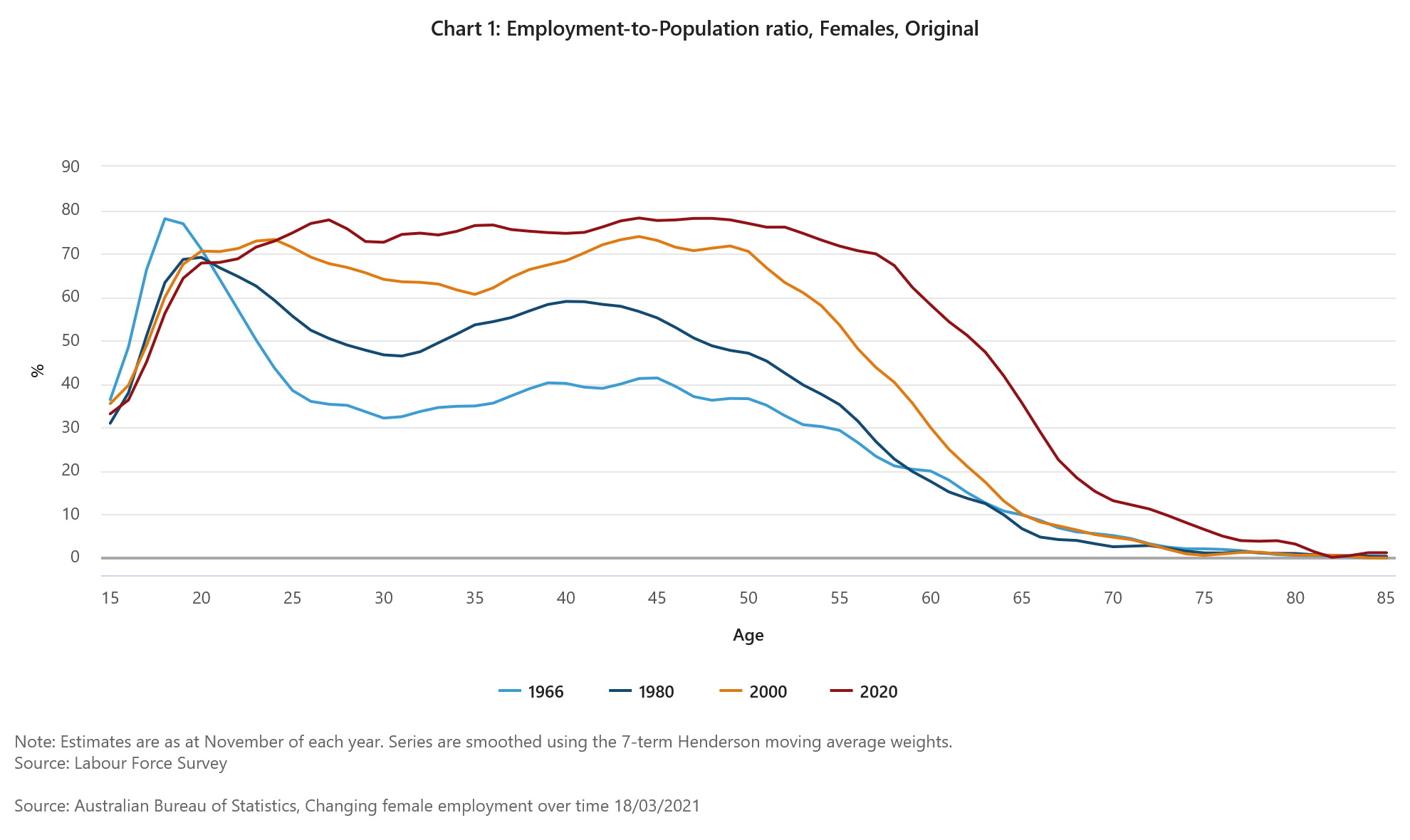
The reason for gender pay gaps is fourfold. Firstly, there is gender discrimination in hiring and salary. Women and men are often not rewarded equally for the same work. Secondly, as we noted above, men and women tend to be concentrated in different types of work which are not equally paid. Thirdly, the unequal distribution of domestic duties, especially child and elder care, means that women often work fewer hours than men and experience disruptions in their career path. Fourthly, the work typically done by women is arbitrarily undervalued with respect to the work typically performed by men. It is certainly questionable that early childhood education occupations dominated by women involve less skill, less training, or less significance to society than many trades dominated by men, but there is a clear disparity in wages between these typically gender segregated types of occupation.
🧠 Learn More
We do not have good data on intersectional pay gaps in Australia. However, data from the United States show considerable differences in pay based on race and gender. We know that in Aotearoa New Zealand, Maori and Pasifika women earn around 23% less than Pakeha men do (StrategicPay, 2022). We also know that Aboriginal and Torres Strait Islander people in Australia have lower incomes than the national average (Australian Institute of Health and Welfare [AIHW], 2021). Thus, we can assume that additional research into Australia’s intersectional pay gap is likely to find similar compounded inequalities.
Beyond the economic sphere, there has been a long history of power relations based on gender. Compared to the past, society has made great strides in terms of abolishing some of the most blatant forms of gender inequality, but the underlying effects of patriarchy still permeate many aspects of society.
🧠 Learn More
Look at a snapshot of recent Australian statistics that show some of the extent of inequity based on gender, and Aotearoa New Zealand gender statistics. Australian data about inequalities experienced by LGBTQIA+ folks are represented in an infographic from the Australian Human Rights Commission. For Aotearoa New Zealand, have a look at the information about social and legal inequalities facing LGBTQIA+ people.
Similarly, discrimination based on LGBTQIA+ stereotypes, misinformation, and homophobia — an extreme or irrational aversion to homosexuality – is unfortunately common. Major policies to prevent discrimination based on sexual orientation have not come into effect until the last few years. In 2017, the Australian government amended the Australian Marriage Act (1961) to allow for same-sex marriages. Marriage is defined, now, as “the union of 2 people to the exclusion of all others, voluntarily entered into for life” (Marriage Act 1961 (Cth) s. 2A). In Aotearoa New Zealand, amendments came a few years earlier in 2013. Some argue that focusing on marriage appeals to heteronormative values, rather than presenting a real challenge to social norms (Richardson-Self, 2012).
Theoretical Approaches
Already in this chapter we have introduced you to a range of theoretical approaches that sociologists use to understand gender, sexuality and families. In this final section, we will briefly summarise those we have already discussed, and explain a few others. We will only lightly touch on these here and encourage you to look further into any of the ideas that you find interesting, or those that you disagree strongly with!
Structural Functionalism
Structural functionalism has been a major influence on research in the social sciences, including gender studies. Viewing the family as the most integral component of society, assumptions about gender roles within marriage assume a prominent place in this perspective. Our discussions of the family as an important site of gender socialisation, above, is informed by functionalist perspectives.
Functionalists argue that gender roles were established well before the preindustrial era when men typically took care of responsibilities outside of the home, such as hunting, and women typically took care of domestic responsibilities in or around the home. These roles were considered functional because women were often limited by the physical restraints of pregnancy and nursing, and unable to leave the home for long periods of time. Once established, these roles were passed on to subsequent generations since they served as an effective means of keeping the family system functioning properly. According to Talcott Parsons (1943), gender roles in families enabled a clear division of labour to ensure the needs of the family were met.
When it comes to sexuality, functionalists stress the importance of regulating sexual behaviour to ensure marital cohesion and family stability. Since functionalists identify the family unit as the most integral component in society, they argue in favour of social arrangements that promote and ensure family preservation. From a functionalist standpoint, homosexuality poses a potential dysfunction in terms of both the procreative role of the family and the unifying myths that the traditional family provides. The functions of the traditional family structure need to be served or satisfied by different family structures for a working social equilibrium to be restored. This analysis suggests that sociologists need to examine new structural forms that provide the functional equivalents of traditional marriage structures: the increasing legal acceptance of same-sex marriage; the emergence of new narratives about what makes a marriage legitimate (e.g., the universality of the 'love bond' rather than the rites of tradition); and the rise in gay and lesbian couples who choose to bear and raise children through a variety of available resources.
Anthropologist George Murdock defined the family narrowly as a group of people who live together, cooperate economically, and comprises children and at least two adults who engage in sexual relationships considered socially appropriate, with a focus on reproduction (Murdock, 1949). Murdock conducted a survey of 250 societies and determined that there are four universal residual functions of the family: sexual, reproductive, educational, and economic (Lee, 1982). In each society, although the structure of the family varies, the family performs these four functions.
Critical Sociology
According to critical sociology, which includes feminist perspectives, society is structured by relations of power and domination among social groups (e.g., women versus men) that determine access to scarce resources. When sociologists examine gender from this perspective, we can view men as the dominant group and women as the subordinate group. According to critical sociology, social problems and contradictions are created when dominant groups exploit or oppress subordinate groups. Our discussions about normativity and inequalities, above, is informed by contemporary critical sociological perspectives.
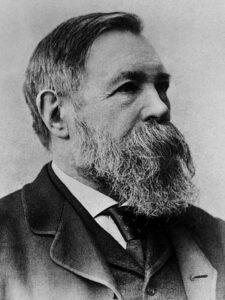
Friedrich Engels, a German sociologist, studied family structure and gender roles in the 1880s. Engels suggested that the same owner-worker relationship seen in the labour force is also seen in the household, with women assuming the role of the proletariat. Women are therefore doubly exploited in capitalist society, both when they work outside the home and when they work within the home (Engels, 1845, as cited in McGregor, 2021).
From a critical sociology point of view, a key dimension of social inequality based on sexuality has to do with the concept of 'sexuality' itself. Sexuality is caught up in the relationship between knowledge and power. The first definition of homosexuality was 'scientific' (at least in terms of the science of the time), but it was in no way independent of the cultural norms and prejudices of 19th century society. It was also not independent of the modern expansion of what Michel Foucault calls 'micro-powers' over an increasing range of facets of the life of individuals (Jessop, 2014). As a public concern, sexuality became a danger to be controlled, surveilled, corrected, and in the worst cases, institutionalised. As Foucault (1980) describes, the sexual lives of children, 'perverts', married couples and the population as a whole became increasingly subject to interventions by doctors, psychiatrists, police, government administrators, moral crusaders, and families.
The feminist slogan of the 1960s and 1970s — 'the personal is the political' — indicates how feminists began to draw attention to the broad social or public implications of matters long considered private or inconsequential, including inequalities within families. As women’s roles had long been relegated to the private sphere, issues of power that affected their lives most directly were largely invisible.
One focus of critical sociology, therefore, is to highlight the political-economic context of the inequalities of power in family life. The family is often not a haven but rather an arena where the effects of societal power struggles are felt. Blood and Wolfe’s (1960) classic study of marital power in heterosexual couples found that the person with the most access to value resources held the most power. As money is one of the most valuable resources, men who worked in paid labour outside of the home held more power than women who worked inside the home.
The political and economic context is also key to understanding changes in the structure of the family. The debate between functionalist and critical sociologists on the rise of non-nuclear family forms is a case in point. Since the 1950s, the functionalist approach to the family has emphasised the importance of the nuclear family — a married man and woman in a socially approved sexual relationship with at least one child — as the basic unit of an orderly and functional society. In reality, though, this household type is not the norm. In Australia, couples with children made up just 29.7% of households in 2021 (IDCommunity, 2023), and in Aotearoa New Zealand in 2018 couple-with-children households were 27.3% of all households (Stats New Zealand, 2020). Critical perspectives emphasise that the diversity of family forms does not indicate the 'decline of the family' so much as the diverse response of the family form to the tensions of gender inequality and historical changes in the economy and society. The nuclear family should be thought of less as a normative model for how families should be, and more as an historical anomaly that reflected the specific social and economic conditions of the two decades following World War II.
Symbolic Interactionism
Symbolic interactionism aims to understand human behaviour by analysing the critical role of symbols in human interaction. This is certainly relevant to the discussion of masculinity and femininity, and our discussions above about ‘doing gender’ demonstrate the symbolic interactionist approach.
Interactionists focus on the meanings associated with gender and sexuality. Since femininity is devalued in patriarchal societies (including in Aotearoa New Zealand and Australia), those who adopt such traits are subject to ridicule or disrespect; this is especially true for boys or men. Just as masculinity is the symbolic norm, so too has heterosexuality come to signify normalcy. The experiences of gender and sexual 'outsiders' reveal the subtle dramaturgical order of social processes and negotiations through which all gender identity is sustained and recognised by others. From a symbolic interactionist perspective, 'passing' as a 'normal' heterosexual person depends on one’s sexual cues and props being received and interpreted by others as passable.
Interactionism might also focus on the slurs used to describe homosexuality. Stereotypes and offensive terms are often used to demean homosexual men by feminising them, and homosexual women by pointing out their failed femininity. This subsequently affects how people perceive themselves. C. H. Cooley’s 'looking-glass self' is a concept which suggests that self develops as a result of one’s interpretation and evaluation of the responses of others (Cooley, 1902). Constant exposure to derogatory labels, jokes, and pervasive homophobia would lead to a negative self-image, or worse, self-hate. The AIHW (2018) reports that LGBTQIA+ people have higher levels of psychological distress than heterosexual adults.
Interactionists also recognise how family status roles are socially constructed, which plays an important part in how people perceive and interpret social behaviour. Interactionists view the family as a group of role players or 'actors' that come together to act out their parts in an effort to construct a family. These roles are up for interpretation. In the late 19th and early 20th century, a 'good father', for example, was one who worked hard to provide financial security for his children. Today, a 'good father' is one who takes the time outside of work to promote his children’s emotional well-being, social skills, and intellectual growth — in some ways, a much more daunting task. Symbolic interactionism therefore draws our attention to how the norms that define what a 'normal' family is, and how it should operate, come into existence. The rules and expectations that coordinate the behaviour of family members are products of social processes and joint agreement, even if the agreements are tacit or implicit.
Queer Theory
Queer theory is a perspective that problematises the manner in which we have been taught to think about gender, sexuality, families, and categories in general. These scholars embrace the word 'queer' and have reclaimed it for their own purposes. Queer theorists reject the dominant gender schema and the dichotomisation of sexual orientations. Rather, the perspective highlights the need for a more flexible and fluid conceptualisation of gender, sexuality, and families — one that allows for change, negotiation, and freedom. Queer theory strives to question the ways society perceives and experiences sex, gender, and sexuality, opening the door to new scholarly understanding.
🧠 Learn More
The video above gives a brief explanation of queer theory [5:36]. To hear about it in more depth, have a look at this 36-minute video essay from Philosophy Tube.
In Summary
- Sex refers to physical characteristics, gender refers to identity and expression, and sexuality refers to preferences, attractions, and desires. It is important to understand the differences between these ideas, as well as how they overlap. All three are the product of social construction because the meanings that are attached to each category are socially and culturally specific.
- Gender socialisation shapes our understandings of gender roles. Socialisation begins at birth, and happens within families, at school, within the media, and more. The gender roles that are produced through socialisation then influence the roles that different family members play within a household and extended family.
- Normativity is where certain ways of being are expected, and society is structured around these ways of being. Our societies are heteronormative, and there are also strong normative beliefs around gender and families.
- Gender and sexuality are the foundation of substantial inequalities around the world, meaning that some people have less access to economic and socio-cultural resources than others.
- Functionalism focuses on the ways that gender roles and family structures create a stable base for society; critical sociology considers inequalities that exist based on gender, sexuality, and within families; symbolic interactionism examines the social construction of these identities, and the impacts on the self of stereotypes based on them; and queer theory invites us to look beyond categories and consider how all expressions of gender, family and sexuality are performances.
References
Australian Bureau of Statistics. (2021). Changing female employment over time. https://www.abs.gov.au/articles/changing-female-employment-over-time
Australian Bureau of Statistics. (2022, October 7). Females do more unpaid work, males do more paid work [Press release]. https://www.abs.gov.au/media-centre/media-releases/females-do-more-unpaid-work-males-do-more-paid-work
Australian Institute of Health and Welfare. (2018). Australia’s health 2018. https://www.aihw.gov.au/reports/australias-health/australias-health-2018/contents/table-of-contents
Australian Institute of Health and Welfare. (2021). Indigenous income and finance. https://www.aihw.gov.au/reports/australias-welfare/indigenous-income-and-finance
Becker, H. S. (1963). Outsiders: Studies in the sociology of deviance. Free Press Glencoe.
Blood, R. O., Jr., & Wolfe, D. M. (1960). Husbands and wives: The dynamics of family living. Free Press.
Burbery, R. (2020). The inner circle of the winner's circle: Exclusionary treatment of transgender and gender diverse athletes in elite sports. Griffith Journal of Law and Human Dignity, 8(2), 70-87. https://griffithlawjournal.org/index.php/gjlhd/article/view/1191/1062
Butler, J. (2004). Performative acts and gender constitution: An essay in phenomenology and feminist theory. In H. Bial (Ed.), The performance studies reader (pp. 154-166). Routledge.
Clark, M. (2015). Indigenous subjectivity in Australia: Are we queer? Journal of Global Indigeneity, 1(1). https://ro.uow.edu.au/jgi/vol1/iss1/7
Coltrane, S. & Adams, M. (2008). Gender and families. Rowman & Littlefield.
Cooley, C. H. (1902). Human nature and the social order. Scribner’s.
Employment New Zealand. (2023). Gender pay gap. https://www.employment.govt.nz/hours-and-wages/pay/pay-equity/gender-pay-gap/
Fausto-Sterling, A. (2000). Sexing the body: Gender politics and the construction of sexuality. Basic Books.
Fine, C. (2017). Testosterone rex: Unmaking the myths of our gendered minds. Icon Books.
Foucault, M. (1980). The history of sexuality, volume 1: An introduction. Vintage Books.
Frederick, D. A., John, H. K. S., Garcia, J. R., & Lloyd, E. A. (2018). Differences in orgasm frequency among gay, lesbian, bisexual, and heterosexual men and women in a U.S. National sample. Archives of Sexual Behavior, 47(1), 273-288. https://doi.org/10.1007/s10508-017-0939-z
Gilding, M. (2001, Spring-Summer). Changing families in Australia 1901-2001. Family Matters, (60), 6-11.
Goffman, E. (1959). The presentation of self in everyday life. Doubleday.
Hacking, I. (2006). Making up people. London Review of Books, 28(16). https://www.lrb.co.uk/the-paper/v28/n16/ian-hacking/making-up-people
Hochschild, A. R. & Machung, A. (1989). The second shift: Working parents and the revolution at home. Viking.
IDCommunity. (2023). Australia: Household type. https://profile.id.com.au/australia/households
International Olympic Committee. (2021). IOC framework on fairness, inclusion and non-discrimination on the basis of gender identity and sex variations. https://tinyurl.com/2epu5554
Jacobs, S-E., Thomas, W., & Lang, S. (1997). Two spirit people: Native American gender identity, sexuality, and spirituality. University of Illinois Press.
Jessop, B. (2014). From micro-powers to governmentality: Foucault's work on statehood, state formation, statecraft and state power. In D. Owen (Ed.), Michel Foucault. Routledge. https://doi.org/10.4324/9781315249032
Kimmel, Michael. (2000). The gendered society. Oxford University Press.
Kinsey, Alfred C. et al. (1948). Sexual behavior in the human male. W. B. Saunders Company.
Larsen, C. S. (2003). Equality for the sexes in human evolution? Early hominid sexual dimorphism and implications for mating systems and social behaviour. Proceedings of the National Academy of Sciences, 100(16), pp. 9103-9104. https://doi.org/10.1073/pnas.1633678100
Lee, G. (1982). Family structure and interaction: A Comparative Analysis. University of Minnesota Press.
Mahar, E. A., Mintz, L. B., & Akers, B. M. (2020). Orgasm equality: Scientific findings and societal implications. Current Sexual Health Reports, 12(1), 24-32. https://doi.org/10.1007/s11930-020-00237-9
Manoa, S., Brown-Acton, P., Utanga, T., & Jensen, S. (2019). Pasifika futures wh? Nau ora: F'INE - Nurturing the future for Pasifika LGBTQI. Pacific Health Dialog, 21(4), 196-198. https://doi.org/10.26635/phd.2019WOS.624
Marriage Act 1961 (Cth) https://www.legislation.gov.au/Details/C2018C00441
McGregor, S. M. (2021). Engels on women, the family, class and gender. Human Geography, 14(2), 186-197. https://doi.org/10.1177/19427786211000047
Mead, M. (1935). Sex and temperament in three primitive societies. William Morrow.
Meyer, M., & Conroy, M. (2022). See it, be it: What children are seeing on TV. The Geena Davis Institute on Gender in Media. https://seejane.org/wp-content/uploads/GDI-See-It-Be-It-TV-2022-Report-v2.pdf
Ministry for Women. (2019). Gender inequality and unpaid work: A review of recent literature. https://women.govt.nz/sites/public_files/Gender%20inequality%20and%20unpaid%20work%20.pdf
Murdock, G. (1949). Social structure. The MacMillan Company.
Murdock, G. P. (1954). Outline of world cultures. Human Relations Area Files.
Murdock, G. P. & White, D. R. (1969). Standard cross-cultural sample. Ethnology, 8(4), 329–369.
Newman, C. E. (2019). Queer families: Valuing stories of adversity, diversity and belonging. Culture, Health & Sexuality, 21(3), 352-359. https://doi.org/10.1080/13691058.2018.1468032
Parsons, T. (1943). The kinship system of the contemporary United States. American Anthropologist, 45, 22-38. https://doi.org/10.1525/aa.1943.45.1.02a00030
Pincus, F. (2000). Discrimination comes in many forms: Individual, institutional, and structural. In M. Adams, W. J. Blumenfeld, R. Castaneda, H. W. Hackman, M. L. Peters & X. Zuniga (Eds.), Readings for Diversity and Social Justice (pp. 31-35). Routledge.
Ready, D. (2001). ‘Spice girls,’ ‘nice girls,’ ‘girlies,’ and ‘tomboys’: Gender discourses, girls’ cultures and femininities in the primary classroom. Gender and Education, 13(2), 153-166. https://doi.org/10.1080/09540250120051178
Richardson-Self, L. (2012). Questioning the goal of same-sex marriage. Australian Feminist Studies, 27(72), 205-219. https://doi.org/10.1080/08164649.2012.678572
Scovel, S., Nelson, M., & Thorpe, H. (2022). Media framings of the transgender athlete as “legitimate controversy”: The case of Laurel Hubbard at the Tokyo Olympics. Communication & Sport, 11(1), 1-16. https://doi.org/10.1177/21674795221116884
Sedgwick, E. K. (1985). Between men: English literature and male homosocial desire. Columbia University Press.
Siminski, P., & Yetsenga, R. (2022). Specialization, comparative advantage, and the sexual division of labor. Journal of Labor Economics, 40(4), 851-887. https://www.journals.uchicago.edu/doi/10.1086/718430
Simmel, G. (1950). The sociology of Georg Simmel. The Free Press. (Original work published 1908)
Smith, S. (2008). Gender stereotypes: An analysis of popular films and TV. Geena Davis Institute on Gender in Media. https://seejane.org/wp-content/uploads/GDIGM_Gender_Stereotypes.pdf
Staples, R. & Johnson, L. B. (2004). Black families at the crossroads: Challenges and prospects. Jossey-Bass.
Stats New Zealand. (2019, March 8). Women in paid work [Press release]. https://www.stats.govt.nz/news/women-in-paid-work
Stats New Zealand. (2020, June 2). New data shows 1 in 9 children under the age of five lives in a multi-family household. https://www.stats.govt.nz/news/new-data-shows-1-in-9-children-under-the-age-of-five-lives-in-a-multi-family-household/
StrategicPay. (2022, October 5). Gender and ethnic pay gap equates to $17.6 billion in lost earnings [Press release]. https://www.strategicpay.co.nz/News/x_post/Gender-and-ethnic-pay-gap-equates-to-176-billion-in-lost-earnings-00300.html
Sullivan, C. T. (2018). Majesty in the city: Experiences of an Aboriginal transgender sex worker in Sydney, Australia. Gender, Place & Culture, 25(12), 1681-1702. https://doi.org/10.1080/0966369X.2018.1553853
West, C. & Zimmerman, D. (1987). Doing gender. Gender and Society, 1(2), 125–151.
Workplace Gender Equality Agency. (2019). Gender segregation in Australia's workforce. https://www.wgea.gov.au/publications/gender-segregation-in-australias-workforce
Workplace Gender Equality Agency. (2023). Gender pay gap data. https://www.wgea.gov.au/pay-and-gender/gender-pay-gap-data
A philosophical approach to understanding truth that focuses on logic and science and rejects alternative approaches such as metaphysics.
A school of thought largely constructed by the famed 'Chicago School' (Blumer, Goffman, Garfinkle, etc.) which focusses on the emerging nature of society through micro-interactions, group members and symbolism.