
1 OER Internationally
Open Educational Resources (OER) are “learning, teaching and research materials in any format and medium that reside in the public domain or are under copyright that have been released under an open license, that permit no-cost access, re-use, re-purpose, adaptation and redistribution by others” (UNESCO, 2019). OER can include open textbooks, videos, images, lesson plans, modules, course materials, games, and software.
OER are based on the idea that sharing knowledge openly can broaden access to learning and help create new knowledge (OECD, 2007). In some cases, the focus has been on bringing resources together in one place to make them easier to discover. In others, the emphasis has been on creating complete open textbooks or sharing materials that other instructors can adapt and build on to immediately in their courses. Alongside these practical developments, international organizations have also helped shape the policy environment that supports OER.
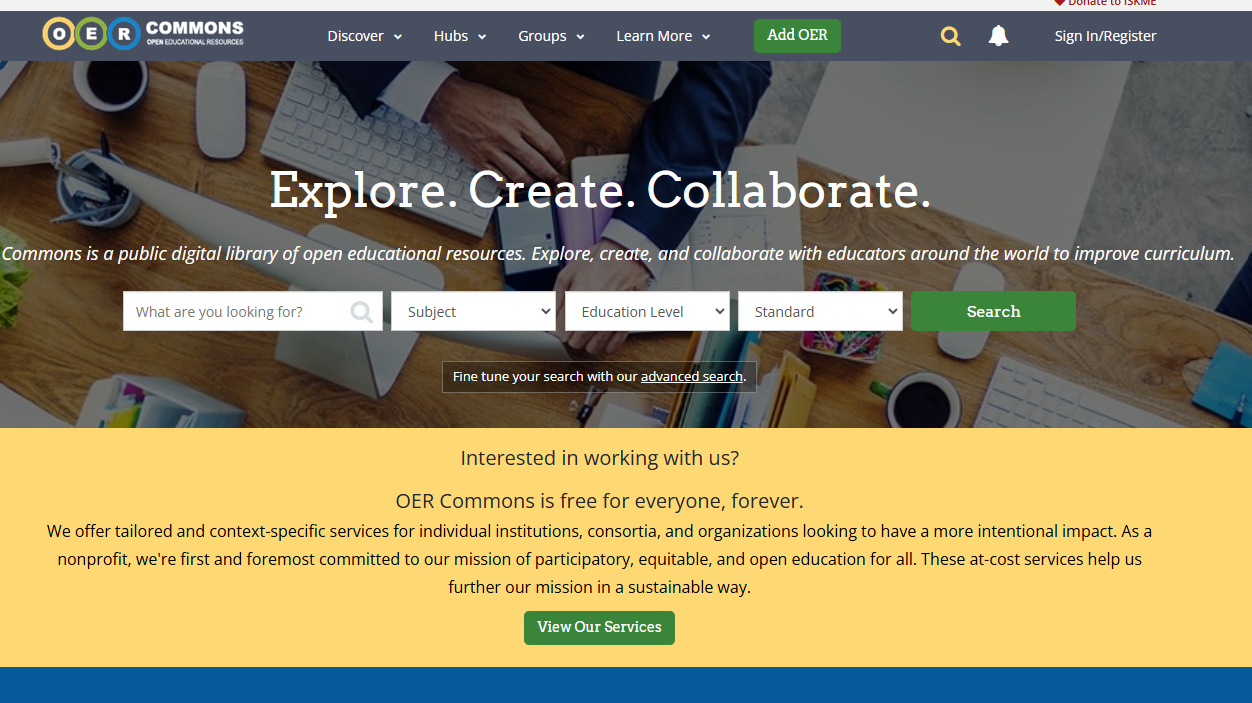
A good example of the first approach is OER Commons, provided by ISKME (the Institute for the Study of Knowledge Management in Education) in the United States. OER Commons brings together more than 50,000 resources from around the world. Rather than harvesting content automatically, the platform allows creators to submit OER with metadata, and shared resources are reviewed by librarians. It also supports thematic and institutional groupings through OER Hubs, making it easier for organizations to organize and share collections of OER. Its built-in Open Author tool allows users to create OER directly on the platform. Resources created in Pressbooks can also be included when providers submit them by URL.
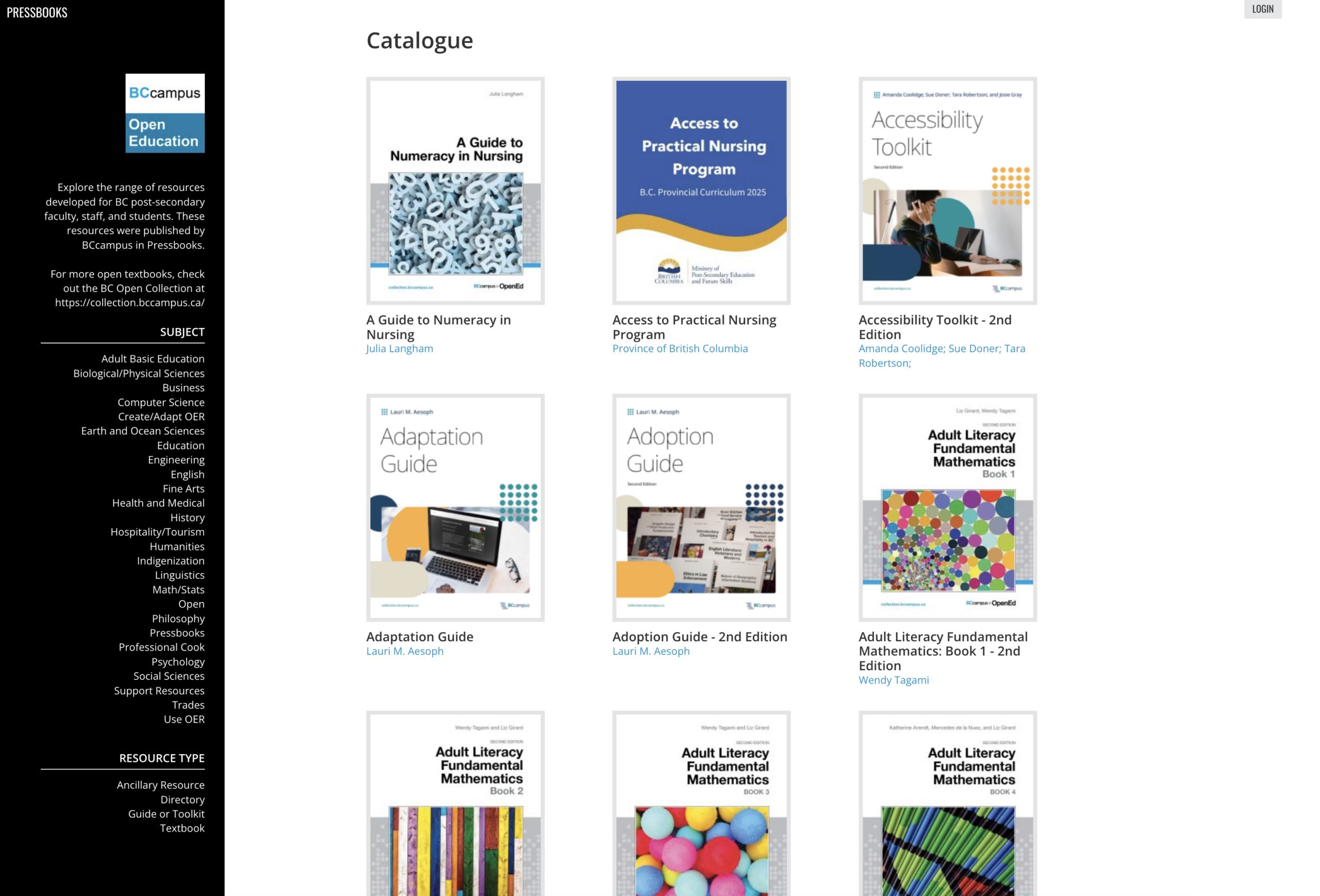
A different model can be seen in BCcampus in British Columbia, Canada, where the focus has been on open textbooks. Through educational grants to instructors, BCcampus has developed a growing collection of freely available textbooks for higher education. This work has also helped advance Zero Textbook Cost (ZTC) programs, which allow students to complete courses or credentials without textbook costs by using OER and other freely available materials. This approach shows how OER can reduce costs for students while also giving educators access to adaptable, real-time digital teaching materials.
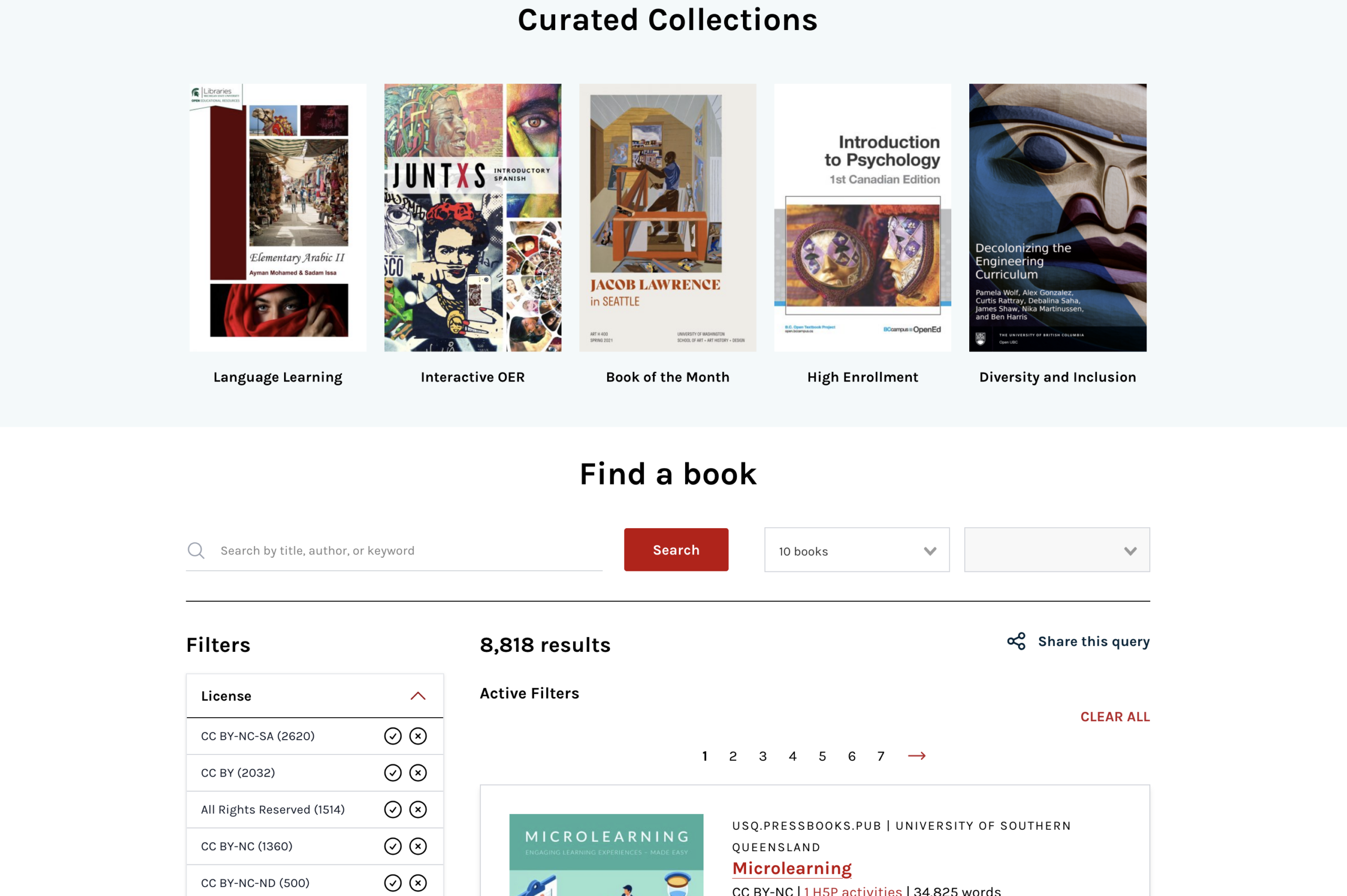
Another popular platform is Pressbooks, which is widely used by educators and institutions to create, publish, and share open textbooks and other OER. Alongside the publishing platform itself, the Pressbooks Directory provides a free searchable catalog of open access books and educational resources created on Pressbooks networks. This makes Pressbooks useful not only for publishing OER, but also for discovering existing materials that can be reviewed, adopted, or adapted for new contexts.
A further resources is OpenStax, which has focused on creating openly licensed textbooks and learning materials that can be used directly in teaching. Its resources are designed with classroom use in mind, and in some cases can be paired with quizzes and other tools that work well in learning management systems. This points to another important direction in OER: not only making materials open, but also making them easy to adopt in practice.
Other well-known collections, such as MERLOT and Project Gutenberg, show the breadth of the wider OER ecosystem. Together, these platforms illustrate that open resources can be organized and shared in many different ways depending on educational purpose, audience, and context.
At the international level, UNESCO has also played an important role in promoting OER. The 2012 Paris OER Declaration encouraged the open licensing of educational materials developed with public funding, while the 2019 UNESCO Recommendation on OER called for stronger support through policy development, capacity building, and wider adoption. These initiatives help show that OER is not only a matter of technology or access, but also part of a broader effort to expand educational opportunity.
As you read this guide, these international examples may help place Japan’s OER activity in a wider context. They show that OER can be supported through platforms, publishing initiatives, and policy frameworks, and that each of these approaches offers useful ideas for the future development of OER in Japan.
Organisation for Economic Co-operation and Development. (2007), Giving Knowledge for Free: The Emergence of Open Educational Resources, OECD Publishing, Paris, https://doi.org/10.1787/9789264032125-en
UNESCO. (2019). Recommendation on Open Educational Resources (OER). https://www.unesco.org/en/legal-affairs/recommendation-open-educational-resources-oer