
Chapter 1: Introduction to Academic Writing
What you will do in this chapter:
1. Practice writing questions
2. Explore the glossary of terms
3. Do a self-assessment
4. Write on a topic
English Questions
To improve your English speaking and listening skills, there are several simple questions and statements that are very useful when seeking information from teachers and classmates.
Exercise 1: Thinking about what you might say in English, write answers to the questions below. Be sure to write complete sentences. Compare your ideas with other students.
a. When you don’t understand the meaning of an English word, what should you say?
______________________________________________________________________
b. When you don’t know the answer to a question, what should you say?
______________________________________________________________________
c. When you don’t know how to spell a word in English, what should you say?
______________________________________________________________________
d. When you don’t understand the class activity, what should you say?
______________________________________________________________________
e. When you don’t know the Japanese translation for an English word, what should you say?
______________________________________________________________________
f. When you don’t know the pronunciation of a word, what should you say?
______________________________________________________________________
g. When someone says something you don’t understand, what should you say?
______________________________________________________________________
Exercise 2: Find the glossary in this book and review it with classmates. How many of the English glossary terms do you already know?
___________________________________________________________________
What Can You Do?
Exercise 3: Think about your English writing ability. What can you do, and how well? Write numbers from the scale in the blanks next to the statements in the table below.
Scale:
- I cannot do this.
- I can do this, but unsatisfactorily.
- I can do this with some confidence.
- I can do this well.
- I can do this extremely well.
| Can write essay introduction paragraphs that include general topic information and a thesis statement. | |
| Can write essay body paragraphs that include a topic sentence and supporting sentences. | |
| Can write body paragraphs that are easy to read and understand (coherence) and focus on a single idea (unity). | |
| Can write essay conclusion paragraphs that include a restatement of the thesis statement and a final comment. | |
| Can apply basic text-formatting conventions to produce typed documents. | |
| Can understand and use basic paraphrase and citation techniques for incorporating information sources in essays. | |
| Can understand and use the writing process. | |
| Can write a brief academic essay of at least 300 words. |
Write It!
Exercise 4: Write a short paragraph about your learning goals for this course.
Preview It!
Introduction to Paragraph Writing: Topic Sentence
A paragraph is a group of sentences that support one main idea. As a general rule, a paragraph should include just one main idea. In academic writing, a paragraph is normally described as having three parts: a topic sentence, supporting sentences, and a concluding sentence.
Topic Sentence
The topic sentence of a paragraph is normally the first sentence. Topic sentences have two parts: the topic and the controlling/main idea (or focus). Since all topics have many aspects, to write well, a writer needs to control the topic by selecting a specific topic focus/main idea to write about. In other words, the controlling idea narrows the topic focus and tells readers specifically what the writer will write about.
Examples: Examine the topic and controlling idea in these topic sentences.
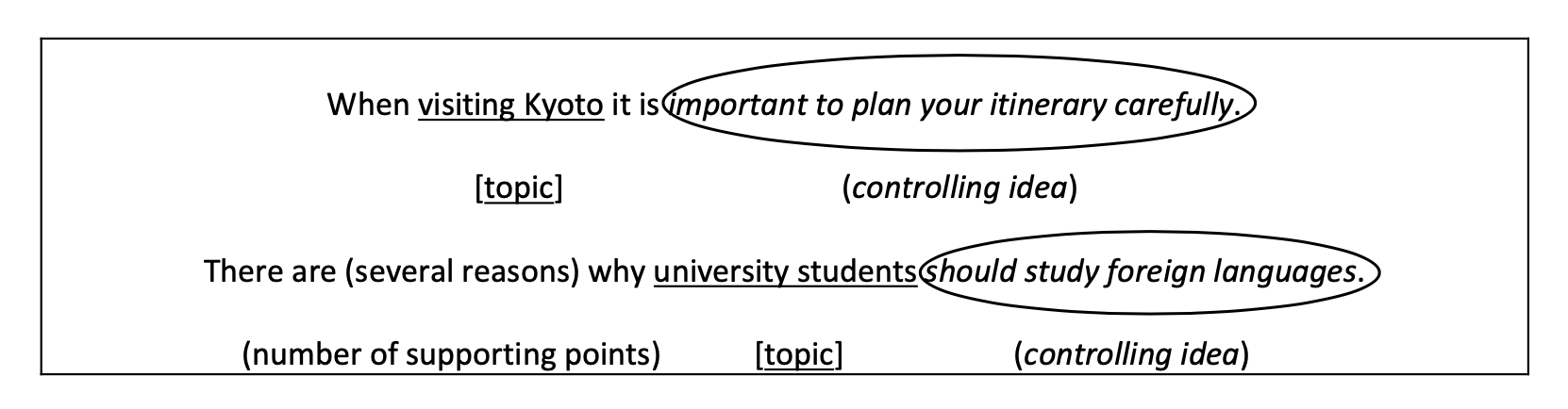
Preview Exercise: Underline (_) the topic and circle (O) the controlling idea for these topic sentences.
1) Ichiro Suzuki deserves to enter the Baseball Hall of Fame for a number of reasons.
2) While tourism benefits cities economically, it can have serious negative effects as well.
3) There are some important ethical issues to consider with the development of gene editing technology.
4) Genetically modified crops have the potential to increase food production for at least three reasons.
5) E-cigarettes are just as harmful as tobacco cigarettes.