
Chapter 9: Essay Structure
What you will do in this chapter:
1. Review/learn parts of academic essays
2. Analyze a model academic essay
3. Review/practice brainstorming topics
4. Begin research on your topic(s)
Learn It!
Academic Essay
An academic essay is a type of writing that informs readers about a topic by explaining, defining or describing a specific, focused topic with supporting evidence so that it is easy for readers to understand. Ideas presented in academic essays must be supported with evidence.
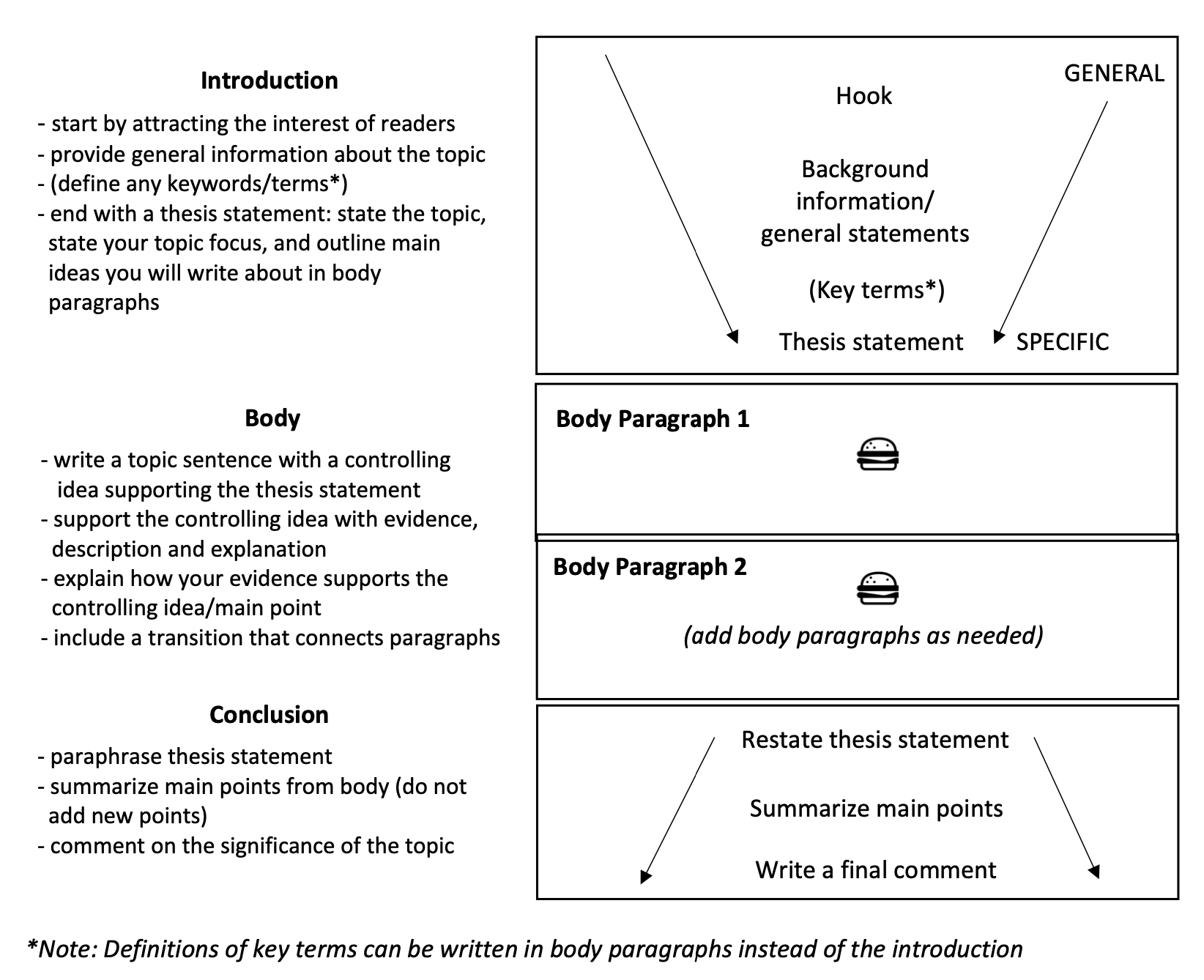
To get a better understanding of basic academic essay structure, review parts of an essay below.
Essay Structure
Model Final Essay
For your final assignment this semester, you will write an academic essay. The first draft should be two to three paragraphs, which will be revised and expanded into a final essay of at least 300 words. The number of paragraphs will depend on your chosen topic and how you develop the main points. Carefully read the model essay below and answer the follow-up questions.
Single-Use Plastic
As the number of people in the world increases, so too does the amount of waste humans produce. This trend is gaining momentum as societies modernize and new goods and services are created. The worldwide distribution of products today is increasing the amount of material waste, notably plastics, which recently has become a major cause for concern. Plastic is a material typically produced with fossil hydrocarbons and is commonly used for packaging.
Single-use plastic, which is intended to be disposed of after only one use, is especially damaging for the environment. Examples of such plastic materials include straws, shopping bags, and food packaging (Giacovelli et al., 2018). Single-use plastic causes many problems, but there are several solutions currently under consideration. Single-use plastic from beauty and food products has certain characteristics that cause problems for the environment. To begin with, common plastics used for containers and wrapping do not reliably break down when exposed to elements in the natural environment. According to Ritchie (2018), the durable plastic used in bottles (e.g., for drinks and shampoos) takes an average of 450 years to biodegrade if not recycled, and even the lightweight plastic bags people use to carry food home from the supermarket take 20 years to break down. Furthermore, research from the United Nations concluded that of the nine billion tons of plastic created as of 2015, just nine percent has been recycled (Giacovelli et al., 2018). Next, the quantity of plastic discarded directly into oceans or in waterways leading to the open ocean is causing large-scale problems. One prominent example is the Great Pacific Garbage Patch – a 1.6 million square kilometer confluence of plastic bottles, bags, and string, floating on the current and ensnaring wild fish and birds (Ritchie, 2018). In addition to the physical danger to wildlife, sea-borne plastic photodegrades, meaning that it slowly breaks down into small fragments from sun exposure. These fragments are called microplastics – defined as tiny plastic particles of between 0.06mm and 0.5mm in diameter (Andrady, 2011) – which can be ingested by animals and humans, potentially leading to numerous health problems. In sum, the amount of plastic created and discarded after just a single use has led to a build-up of plastic waste, which damages the natural environment and carries serious risks for all of the animals in the food chain.
In order to begin to mitigate these problems, there are a number of changes that both individuals and institutions could enact. To start with, since much of the single-use plastic waste results from purchases of food and drink products, each person should consider their own habits in order to reduce plastic consumption. According to the World Wildlife Fund (“Ten Tips,” n.d.), less than 1% of disposable foamed plastic cups can be recycled even if they are collected correctly; in addition, plastic straws and cutlery can take up to 200 years to degrade naturally. As a good first step toward tackling this problem, individual consumers can alter their behavior by, for example, carrying a reusable drink container, lunchbox, and cutlery. More significantly, broader societal change can be directed by commercial and governmental institutions. Examples of organizational measures could include discouraging use of single- use plastics in shops and businesses (see Giacovelli et al., 2018). While Japan has committed to a 25% reduction by 2030, there is a total ban on single-use plastic in Europe from 2021. In addition, governments and corporations have begun to co-fund research into making completely recyclable and biodegradable plastics (Giacovelli et al., 2018). By adopting measures like these, large social institutions might be able to gradually change the types of plastics available, while individuals change how they use them.
In conclusion, the problems caused by single-use plastic are serious and require immediate attention to resolve. Problems include generation of microplastics that enter ecosystems worldwide. Although individuals can certainly change how they purchase and use plastics, it is up to governments and corporations to help create a society where the plastics produced are effectively recycled and used more responsibly. In the final analysis, the problems humanity is creating by producing and throwing away growing amounts of non-degradable plastic waste needs to be resolved by each individual’s actions.
(693 words)
References
Andrady, A. (2011). Microplastics in the marine environment. Marine Pollution Bulletin, 62(8), 1596-1605.
Giacovelli, C., Motoda, T., Doi, A., & Minamino, M. (2018). Single-use plastics: A roadmap for sustainability. United Nations Environment Programme. https://www.unep.org/resources/report/single-use-plastics-roadmap-sustainability
Ritchie, H. (2018). FAQs on plastics. Our World in Data. https://ourworldindata.org/faq-on-plastics
World Wildlife Fund. (n.d.). Ten tips to reduce your plastic footprint. World Wildlife Fund UK. https://www.wwf.org.uk/updates/ten-tips-reduce-your-plastic-footprint
Exercise 1: Answer the following questions and check your answers with classmates.
1. What keywords are defined in the introduction of this essay? Why?
2. Find the thesis statement for this essay. Underline the topic and circle the topic focus.
3. Underline the topic sentence for each body paragraph. What are the controlling ideas for each topic sentence?
4. Find one supporting sentence with a citation in each body paragraph.
5. Go back to the beginning of this chapter and reread the description of features to include in a conclusion. Where are these features written in the model essay conclusion?
Learn It!
Write It!
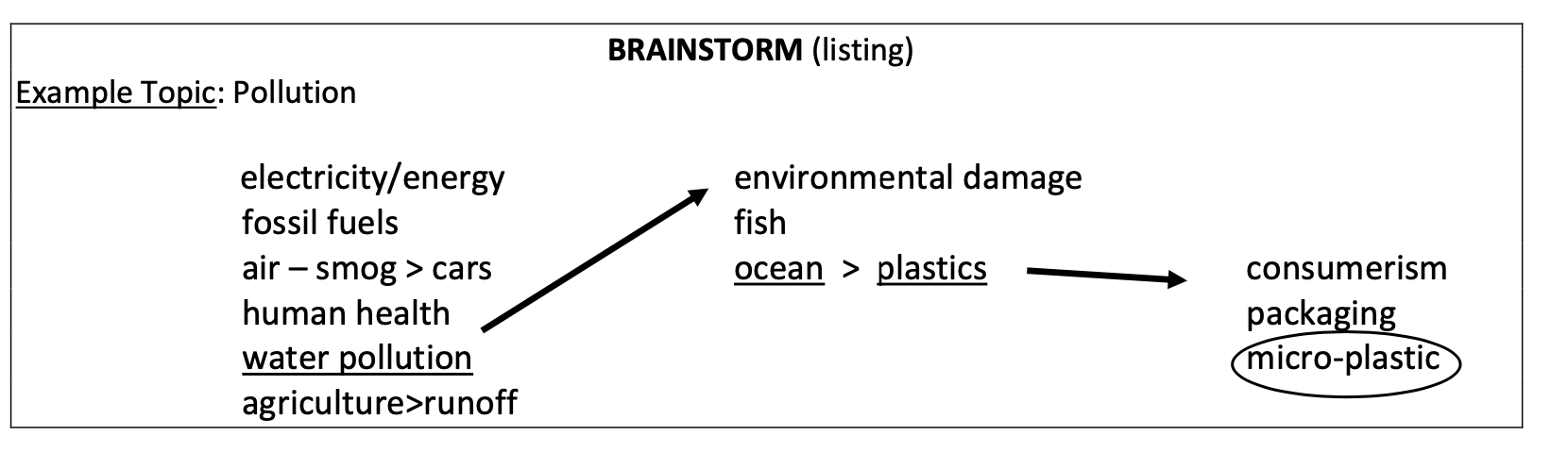
Exercise 2: Your essay topic might be assigned by your teacher or could be something that you are interested in knowing more about. Brainstorm some possible topics below by using the mind mapping (see Chapter 5, or listing technique.
BRAINSTORM
Possible Topics: ____________________ _____________________ ____________________
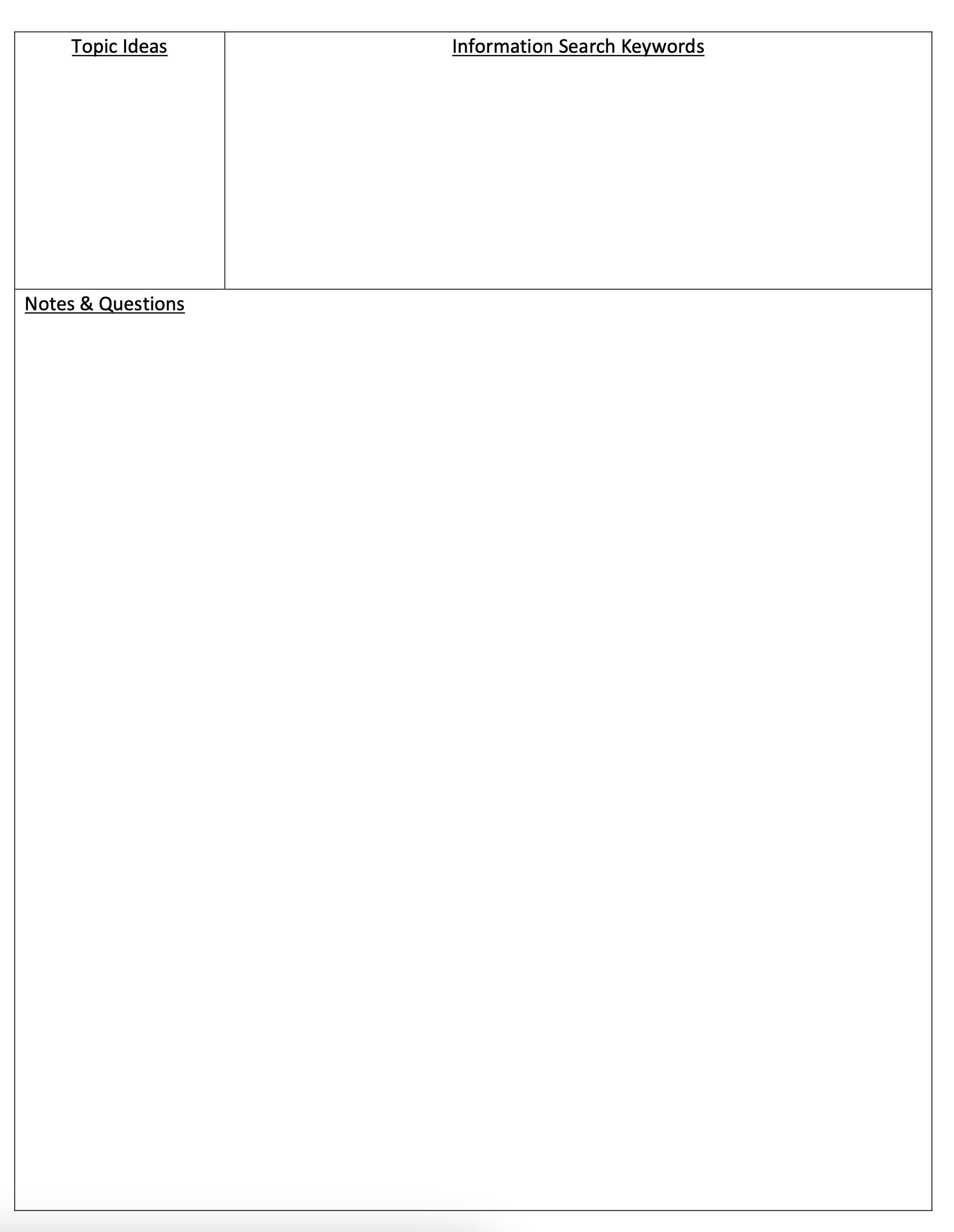
Exercise 3: Do some research for your topic(s) and choose one for your final essay.
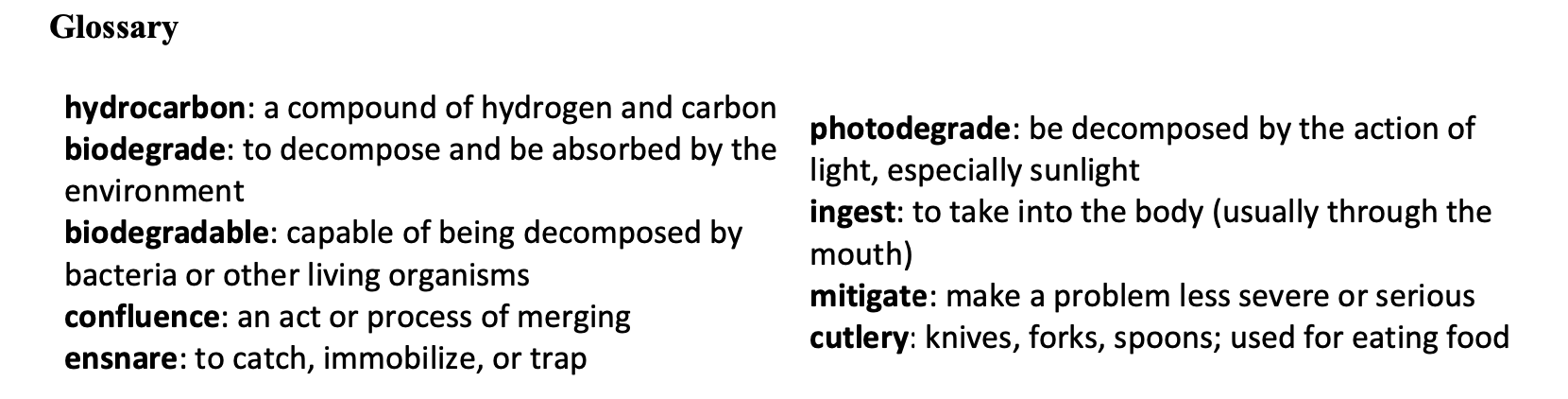
a compound of hydrogen and carbon
to decompose and be absorbed by the environment
an act or process of merging
to catch, immobilize, or trap
be decomposed by the action of light, especially sunlight
to take into the body (usually through the mouth)
make a problem less severe or serious
knives, forks, spoons; used for eating food
capable of being decomposed by bacteria or other living organisms