Chapter 13: Revising & Documenting
What you will do in this chapter:
1. Learn and practice basic reference list entries
2. Practice revising
3. Proofread and revise first draft of essay
Learn It!
Documenting Information Sources
There are a number of different documentation systems. Chapter 8 introduced the American Psychological Association (APA) format. Below is basic information on how to document a source in the reference list using the APA format. For further details, see Appendix 4.
I. Book (more than one author)
Family name, Initials., & Family Name, Initials. (year). Title. Publisher.
II. Web-based Newspaper/Magazine
Family name, Initials. (year, Month day). Title. Name of Publication. URL
III. Non-English Source (academic journal article)
Family name, Initials. (year). Original title written using English alphabet [English translation]. Journal Title, Volume(Number), pages. URL
Practice It!
Exercise 1: For source a and b, rewrite the information into the correct APA reference list format in the space provided below.
Source a (journal article online)
Article title: データ・サイエンティストがビッグデータで私たちの未来を創る
Author: 樋口知之
Volume: 56
Number: 1
Year of publication: 2013 年
Journal title: 情報管理
Pages: 2-11
URL: http://dx.doi.org/10.1241/johokanri.56.2
Source b (magazine online)
Title: Do scientists need an AI Hippocratic oath? Maybe. Maybe not
Author: Susan D’Agostino
Date: June 9, 2022
URL: https://thebulletin.org/
Name of publication: Bulletin of the Atomic Scientists
References
Exercise 2: Which documentation format is used in your area of study? Compare that format with the examples from the APA above.
Revising an Essay
Exercise 3: Read the following body paragraph and the teacher’s comments. Use the comments to improve the paragraph.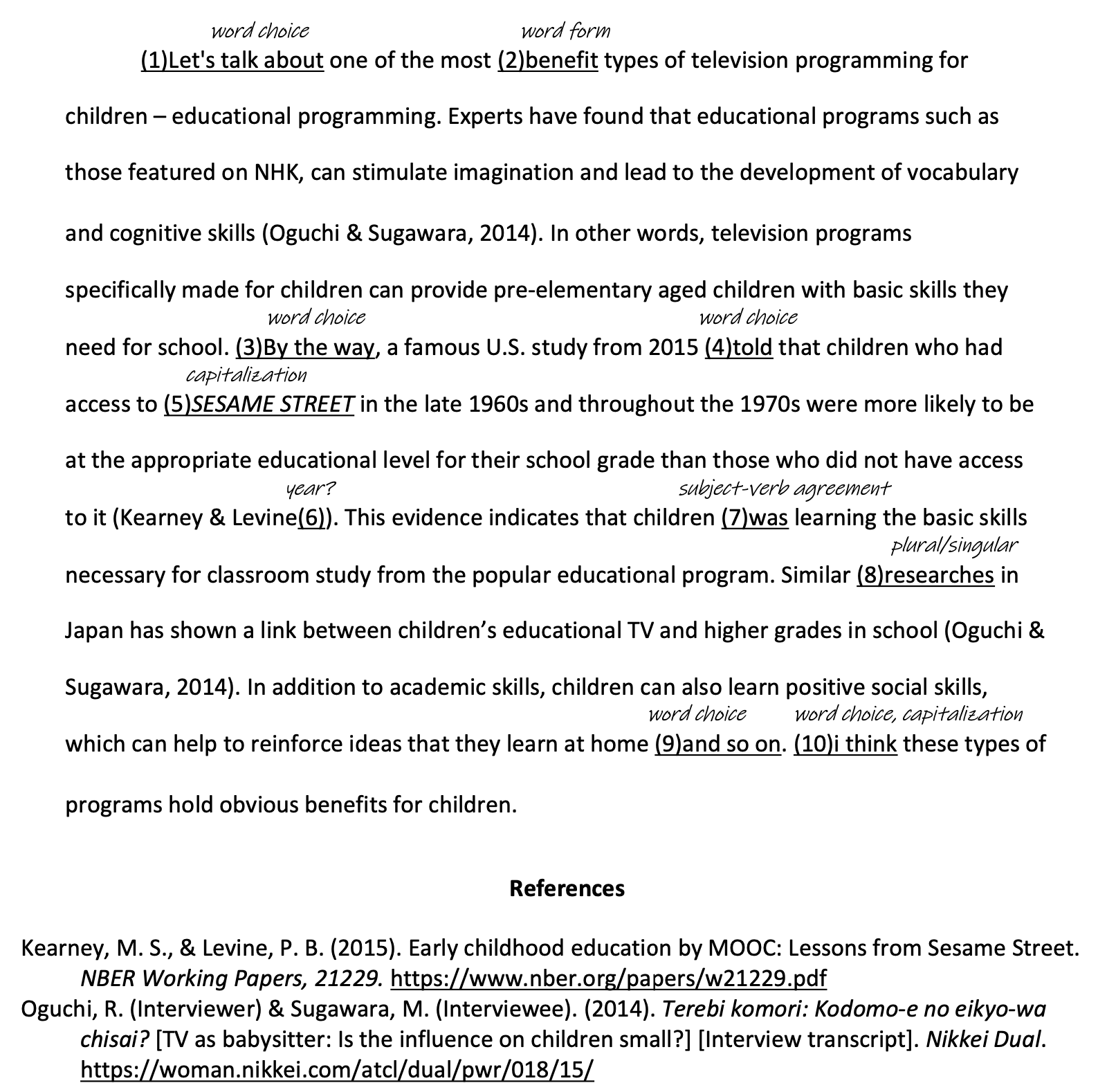
Corrections
1) ________________________________ 6) ________________________________
2) ________________________________ 7) ________________________________
3) ________________________________ 8) ________________________________
4) ________________________________ 9) ________________________________
5) ________________________________ 10) _______________________________
FYI
What’s in a name?
You already know that an author’s last name (family name) is normally used when citing sources. However, this can be slightly confusing if you are unfamiliar with names of different origins. Japanese names are typically listed by last name followed by the first name (e.g., Kyodai Yoko). But many online sources or book covers will list names in the opposite order, starting with the person’s first name. There is no quick solution to identify what is a person’s first or last name, but simply being aware of this issue is a starting point. When in doubt, look it up!
How to spell Japanese names?
Whenever you write reports and essays at university, you will likely use some Japanese-language sources or write about a Japanese topic or concept. If the essay is written in English, you will need to romanize Japanese words and names. There are a few different ways to write Japanese sounds with the English alphabet. Below are some points to keep in mind when you need to write Japanese names or words in an English text:
- Italics and Japanese terms – Use italicized letters for Japanese words (and other non-English words) used in your writing, except for words that can be found in a standard English-language dictionary (e.g., sushi, matcha, karaoke, haiku, ikebana, anime, manga, tsunami)Examples: traditional osechi cuisine; ekiden; facets of amae
- Capitalization – Follow capitalization rules for English writing (see Chapter 12 Learn It! for more information)Examples:
Tatemae refers to one’s public persona.
The short story collection Ai no Yume toka
Akage no An
Asahi Shimbun
Jinko Chino: Sono Totatsuten to Mirai
See Appendix 6 for more information.
Write It!
Step 6: Revise your essay and submit it.
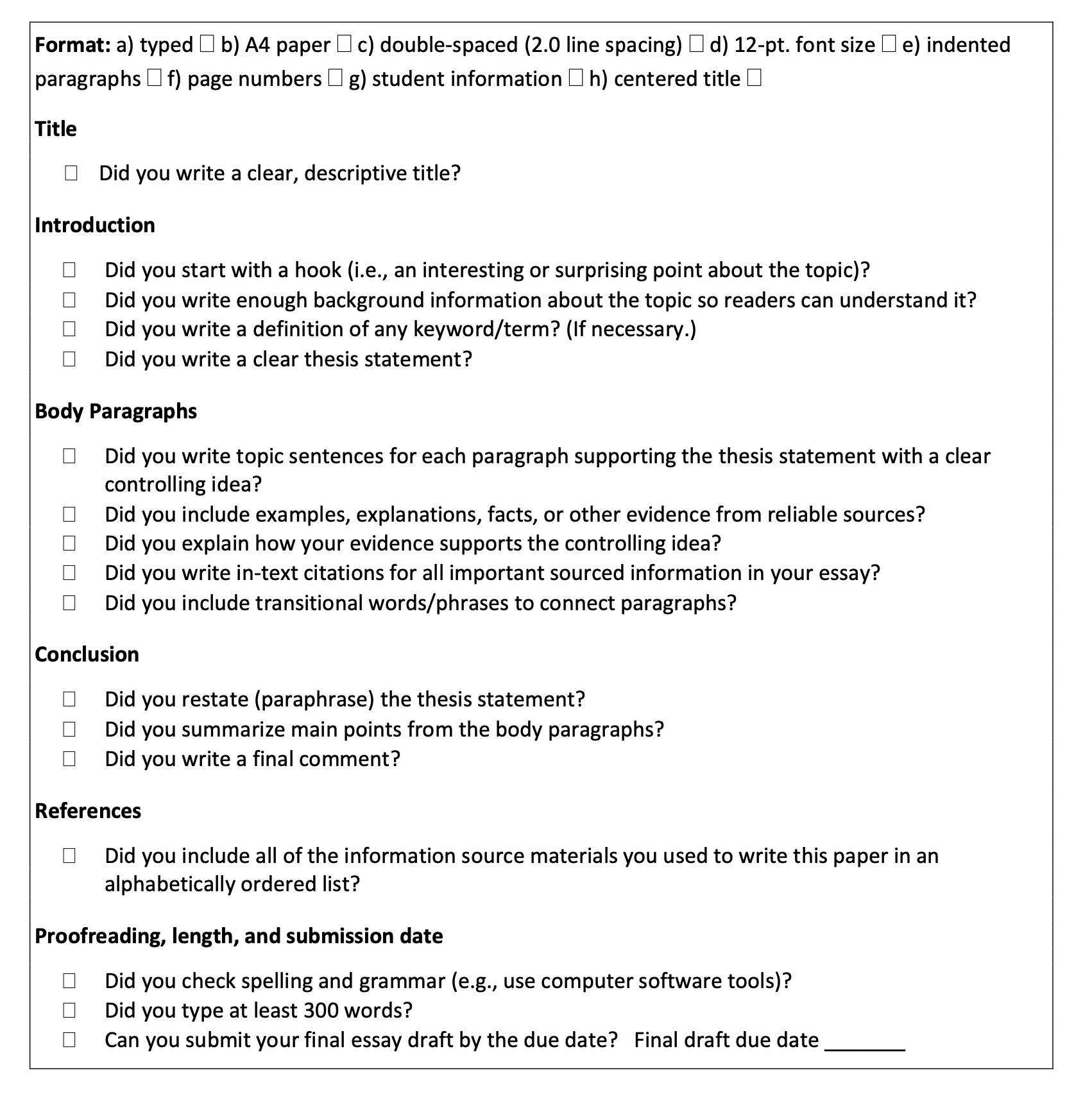
Exercise 4: Use the checklist below to prepare the final draft of your essay. Check (✓) the box for each of the items included in your essay draft.
Essay Checklist