
Chapter 5: The Writing Process
What you will do in this chapter:
1. Review paragraph structure and compare it with essay structure
2. Analyze a model essay
3. Learn about body paragraphs
4. Learn the writing process
5. Brainstorm and focus a topic
Review It!
Paragraph to Essay
To remember the structure of a paragraph, imagine a ___________. The top and bottom (buns) are similar because the last sentence restates the controlling idea introduced at the start. Moreover, the top and bottom parts hold all of the juicy information together as one whole unit.
Exercise 1: Complete the sentences for the “hamburger” paragraph structure below.

Learn It!
Essay Structure
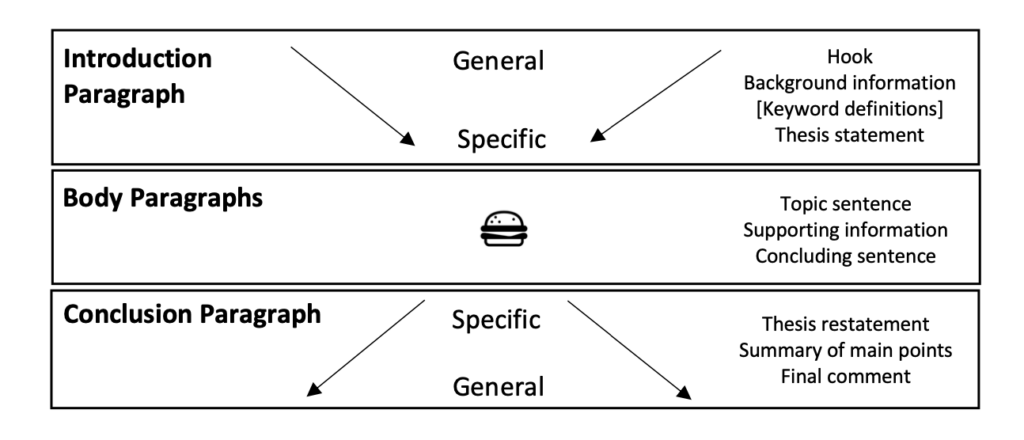
The first four chapters of this book focused on writing the parts of body paragraphs: topic sentence, supporting sentence(s), and concluding sentence. Beginning with this chapter, you will learn to write an essay that consists of introduction, body, and conclusion paragraphs. The basic outline of an essay is illustrated below:
Model Essay
Exercise 2: Read the model essay and answer the questions below.
Storytelling and the Brain
There is an ancient Hopi Native American saying: “Those who tell the stories rule the world.” Indeed, stories are a crucial part of culture and society, and since the beginning of humanity, stories have been used to teach and entertain people of all ages. The transfer of knowledge and wisdom through the format of a story seems to have the power to compel and to compel persuade people much more than other means of communication. Recent something research in neuroscience is shedding light on the reasons why storytelling is neuroscience: the study of the brain and the an effective communication tool. More specifically, stories can affect the nervous system human brain in two ways, which might explain their efficacy to convey ideas.
With the development of magnetic resonance imaging (MRI), researchers results have found that listening to a story has two significant effects on the brain. The first effect is called neuro coupling. This phenomenon occurs when two people have matching activity in the same areas of their brain. Researchers at Princeton University did a study (Stephens et al., 2010) in which brain scans using MRI technology were taken of speakers telling a story and of listeners while listening to a recording of the story. The scans showed synchronized neural activity in the brains of the storyteller and the listener, but the neuro time or speed coupling disappeared when there was a disruption in communication. Thus, it appears that interpersonal communication is most successful when a speaker can stimulate corresponding brain activity in a listener through storytelling. The second effect of stories on the brain is related to increased levels of oxytocin, a hormone produced in the body that is typically associated with trust, cooperation, and other prosocial behaviors between A series of studies demonstrated how dramatic stories can trigger the release of oxytocin, with positive effects on participants’ behavior (Zak, 2015). Zak claims that when people treat others well, their brains synthesize oxytocin which in turn builds trust and leads to reciprocal treatment. While this process illustrates how storytelling might affect the human brain and lead to feelings of empathy and trust amongst individuals, more research is beneficial needed to fully understand the effects of oxytocin on the brain.
In conclusion, the power of storytelling has been recognized throughout the ages, but now there is clinical data to support this claim. When listening to a story, the human brain can be changed because the listener’s brain imitates the storyteller’s brain patterns, subsequently releasing chemicals that can produce positive feelings and behaviors. In this way, stories may have the power not only to change the brain, but also to change the world by helping people become more tolerant and empathetic. (435 words)
References
Stephens, G. J., Silbert, L. J., & Hasson, U. (2010). Speaker-listener neural coupling underlies successful communication. Proceedings of the National Academy of Sciences of the United States of America, 107(32), 14425–14430. https://doi.org/10.1073/pnas.1008662107
Zak, P. J., (2015). Why inspiring stories make us react: The neuroscience of narrative. Cerebrum: The Dana forum on brain science, 2.
1. What is the topic of this essay?
2. At the end of the introduction, what topic focus is stated?
3. For the body paragraph, underline the topic sentence. What is the controlling idea?
4. What main supporting points are explained in the body paragraph?
5. What words or phrases helped you to find the main supporting points?
6. Why is some information in parentheses: (Stephens et al., 2010), (Zak, 2015)?
Learn It!
Body Paragraph
A body paragraph is part of the main section of an essay. To understand body paragraphs better, learn their location, function, and features.
- Location – after the introduction paragraph and before the concluding paragraph
- Function – provides main points about the thesis statement focus which are supported by examples, explanations, and external sources (e.g., books, websites, and articles)
- Features – contains a topic sentence, supporting sentences with details, and a concluding sentence that may link to the next body paragraph
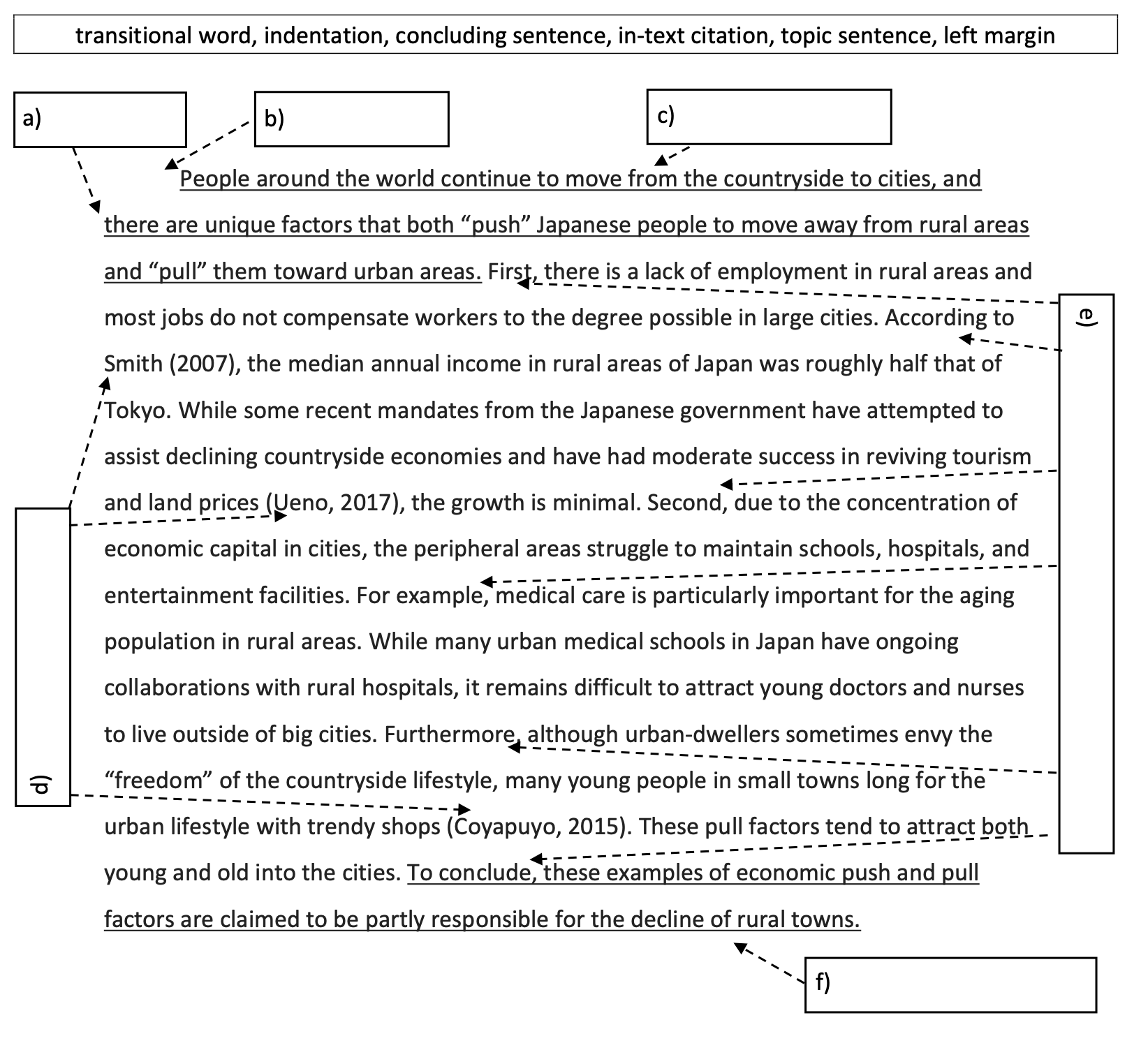
Exercise 3: Use the words in the box below to label this body paragraph.
Process Writing
In this book, you will work through a number of steps to write academic papers. This is called the writing process. Examine the six steps below.
Step 1: Think of a topic and start doing research
- Brainstorm: write down anything you know about the topic
- Select a topic that is feasible, researchable, relevant, and interesting
- Do some basic research/reading on the topic
- As you read, write questions that you might want to explore about the topic
Step 2: Develop a general topic into a specific topic
- From your brainstormed ideas and initial research, develop a general topic into a specific topic (not too vague, nor too specific)
- Continue to research the topic with your specific focus in mind
Step 3: Create an outline
- Write a title and thesis statement (these can change as you research and write your essay)
- Write each main point to support the thesis and think of details you could add from your research (data, examples, explanations, facts)
Step 4: Type an essay draft
- Write an introduction paragraph, body paragraphs, and a concluding paragraph
- Type your essay and use proper formatting (include: your name, student number, a title, double- spacing, indented paragraphs, page numbers, etc.)
Step 5: Get feedback on your writing
- Ask your teacher and/or classmates to read your paper and give you advice
- Think carefully about the advice
Step 6: Revise your essay
- Make changes to your typed first draft to improve your essay
- Carefully proofread your essay final draft, paying attention to details like spelling and punctuation
- Submit your essay
FYI
Formatting your paper
Step 4 of the writing process mentions using proper formatting when typing your essay. There are some standards for formatting an academic paper, and these guidelines help make your essay easier to read. For example, this font (Times New Roman, 12pt.) is much easier to read than this font (Snell Roundhand, 11pt.). If you are not sure what settings to choose for the format, ask your teacher. You may want to ask these questions:
- What font style and size should I use?
- Should the text be double-spaced?
- Where should I put my name, student ID, and class?
Learn It!
Step 1: Think of a topic
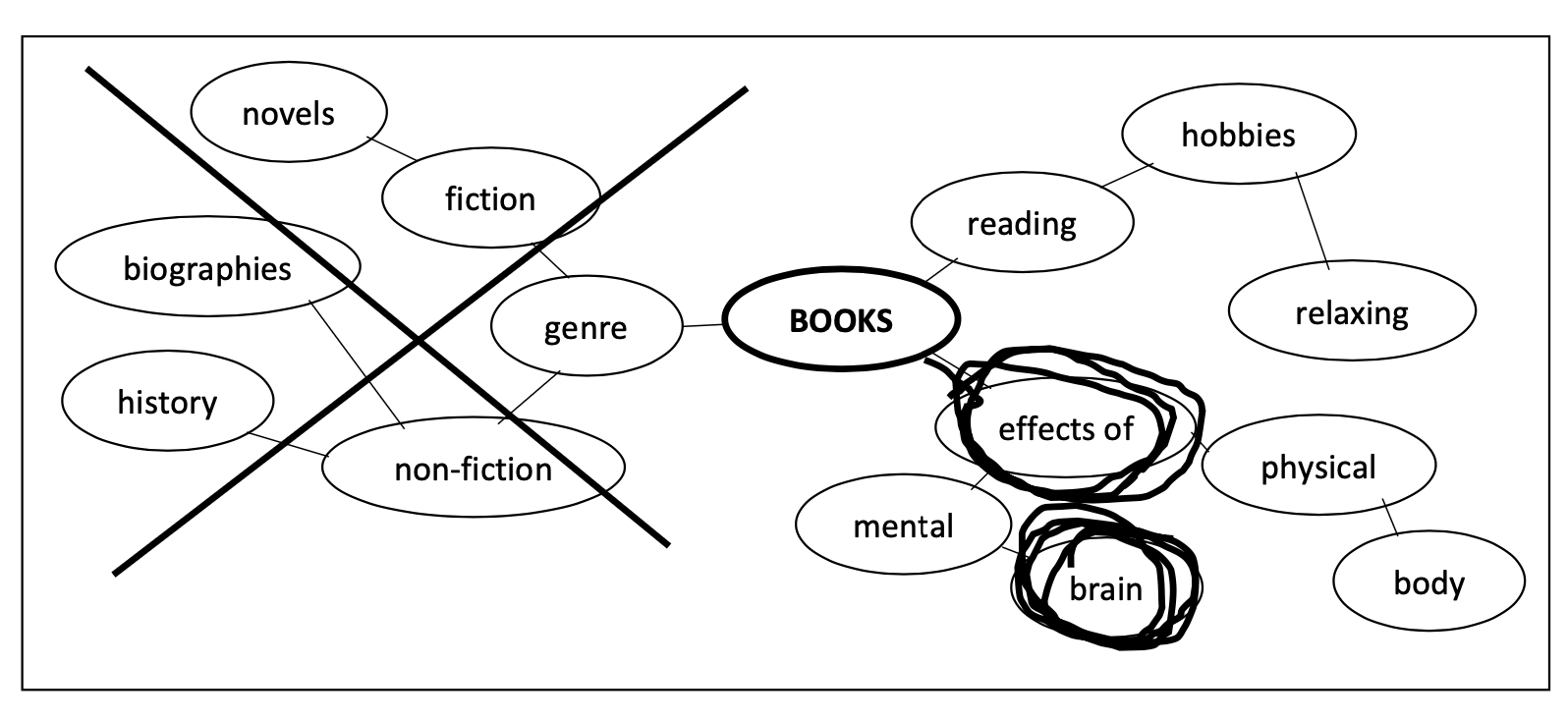
Brainstorming
Practice It!
Exercise 4: Write down one or more topics that interest you. Then, think about what you know about the topic(s) and write some keywords in the space below.
Topic Idea(s):
Learn It!
Evaluate Your Topic
When choosing an essay topic, it is important to consider: 1) whether or not the topic is suitable for your level of knowledge and the writing assignment, 2) how much time you have to write the essay, and 3) with what kind of thesis – or purpose /question – the topic would be compatible.
Criteria for Topic Selection
- Feasible: You need to choose a topic broad enough to write about, but not so big that you cannot complete it (Is it possible to write about this topic within the time limit and word limit?)
- Researchable: You need to be able to find information to support your topic in books, journals, and other sources (Is there information/data about your topic available in different types of sources?)
- Relevant: Your topic needs to be important enough for other people to benefit from reading about it (Is the topic something people are generally concerned about?)
- Interesting: Your topic needs to be interesting enough to motivate you to research and write about it (Is the topic challenging and intriguing enough to investigate?)
Practice It!
Exercise 5: Look at the topic which you brainstormed in Exercise 4 and check it with the criteria for an appropriate essay topic listed above. If your topic meets the criterion, put a checkmark (✓) in the box.
Checklist
◻︎ Feasible
◻︎ Researchable
◻︎ Relevant
◻︎ Interesting
Learn It & Practice It!
Step 2: Focus your topic
Exercise 6: Look at the chart below and consider the topic examples. Develop the four vague topics into specific topics, before working on a topic you might decide to research and write about.
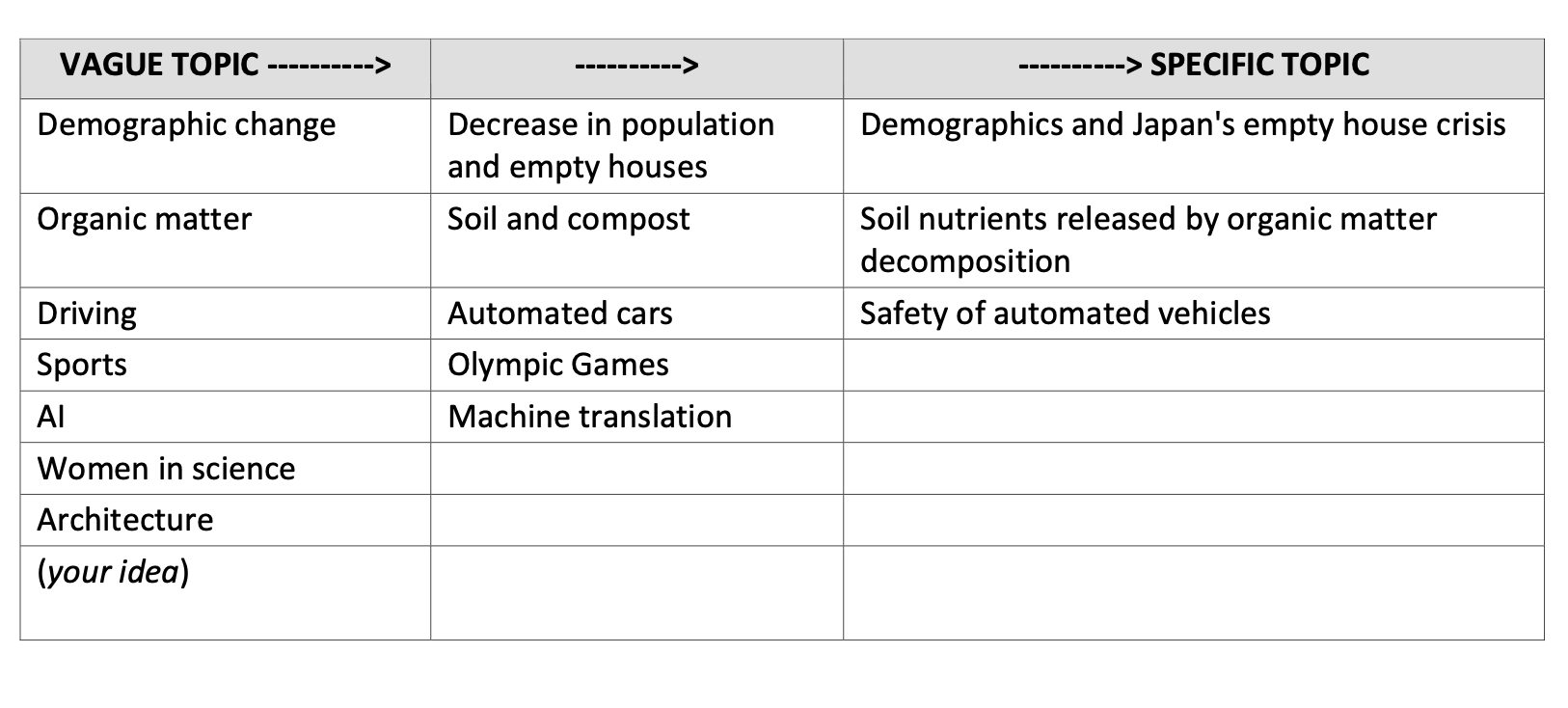
Exercise 7: Look at your specific topic from Exercise 6. Check it again with the criteria for an appropriate essay topic. If your topic meets the criterion, put a checkmark (✓) in the box.
Checklist
◻︎ Feasible
◻︎ Researchable
◻︎ Relevant
◻︎ Interesting
to force or pressure to do something
the study of the brain and nervous system
the ability to produce expected results
happening at the same time or speed
separation or division
benefitting other people
to produce a substance by combining elements through a chemical process
mutually beneficial