
Chapter 11: Definitions, Opinions, Facts, & Format
What you will do in this chapter:
1. Learn a method for writing definitions of keywords/terms
2. Practice writing definitions
3. Identify the difference between “fact” and “opinion”
4. Type and proofread an essay draft
Learn It!
In academic writing, it is important to describe topics clearly so that readers can understand what you want to tell them. To make your meaning clear, defining keywords and terms is an essential element of academic writing. Below are parts typically found in definitions of keywords.
Parts of Basic Definitions
1) keyword/term,
2) word class/type,
3) unique features,
4) example-explanation (optional)
Examples:
Topic: Manga
Manga are comics or graphic novels created in Japan. There are at least two distinguishing features of manga compared with other comics: firstly, manga are typically hand-drawn in black and white shades and; secondly, they are image-based rather than text-based. This means that there is not much text or dialogue in most manga. Consequently, manga can be read quickly and appear in weekly installments like Shonen Jump.
Topic: English for General Academic Purposes
English for General Academic Purposes (EGAP) is a type of English used for study. The unique feature of EGAP is that it emphasizes English language skills that can be used across disciplines. In other words, the key distinguishing characteristic of EGAP is that it is language and skills used for general, not specific, purposes. Examples of general academic skills are paraphrasing, summarizing, and quoting.
Topic: Plagiarism
Plagiarism is a misrepresentation of originality. It is a process, usually associated with written work, of using the ideas, thoughts or expressions of others as though they were your own. The special characteristic of plagiarism is that the writer (speaker) represents the ideas, data or expressions as their own work because they failed to include any citation of the original work. Copying and pasting information into your writing is dishonest unless you quote it, cite the source, and comment on the quoted material. In higher education, plagiarism is considered to be a type of cheating or even theft of intellectual property and can result in serious consequences if proven.
Practice It!
Exercise 1: Read the introduction below from the model essay in Chapter 9. Find the definitions for plastic and single-use plastic. Label the parts of the definitions.
Single-Use Plastic
As the number of people in the world increases, so too does the amount of waste humans produce. This trend is gaining momentum as societies modernize and new goods and services are created. The worldwide distribution of products today is increasing the amount of material waste, notably plastics, which recently has become a major cause for concern. Plastic is a material typically produced with fossil hydrocarbons and is commonly used for packaging. Single-use plastic, which is intended to be disposed of after only one use, is especially damaging for the environment. Examples of such plastic materials include straws, shopping bags and food packaging (Giacovelli et al., 2018). Single-use plastic causes many problems, but there are several solutions currently under consideration.
Exercise 2: Choose a keyword from your essay outline and write a definition for it below.
Keyword: ____________________ _______________________________________________________________________________________ _______________________________________________________________________________________ _______________________________________________________________________________________
Learn It!
Academic essays need to be researched using sources (e.g., research articles, scholarly books, encyclopedias, textbooks, newspapers, and websites). It is important to use credible information sources. Credibility can be paraphrased as believability or trustworthiness. In other words, can we believe and trust the information that we read or hear in an information source? For academic writing, credible source material should not be simply statements of opinion; it needs to be objective and supported by adequate evidence. The best quality research builds on other high-quality research.
Comparing Facts and Opinions
Facts refer to things that can be proven true or verified, whereas opinions refer to personal judgments or beliefs.
| Comparison Categories | Fact | Opinion |
| Basic defining feature | Verifiable statement | Subjective statement |
| Representation | A thing that actually happened | A viewpoint or assumption about something |
| Basis | Observation or research evidence that can be proved to be true | Assumption or personal view not supported by evidence and difficult to prove true |
| Language for describing |
Exercise 3: Look at the following statements with a classmate and based on information in the chart above, decide if they are fact (F) or opinion (O).
a. ___ Tokyo is the most populous city in the world.
b. ___ In most countries, cities continue to grow larger.
c. ___ Melbourne is the best city to live in.
d. ___ The origin of electric blues music can be traced to the city of Chicago.
e. ___ Jazz music is more entertaining than classical music.
f. ___ One example of a classical composer is Wolfgang Amadeus Mozart.
Write It!
Exercise 4: Write two facts about your essay topic below and share these with classmates.
Fact 1: ________________________________________________________________________________
Fact 2: ________________________________________________________________________________
Step 4: Type an essay draft
Exercise 5: Write the first draft of your essay with an introduction paragraph, body paragraphs, and a conclusion paragraph. The steps below are a general guide on format. Be sure to type and format your essay according to your teacher’s specifications.
Steps to formatting an essay
1. Start a new document
8. Type your name and student number in the upper left corner.
9. Type your title in bold with a font size of 12-14 point, and center it.
10. Make sure the rest of your document is left justified (all lines are flush left).
11. Push the “Tab” key each time you make a new paragraph and indent 1 centimeter.
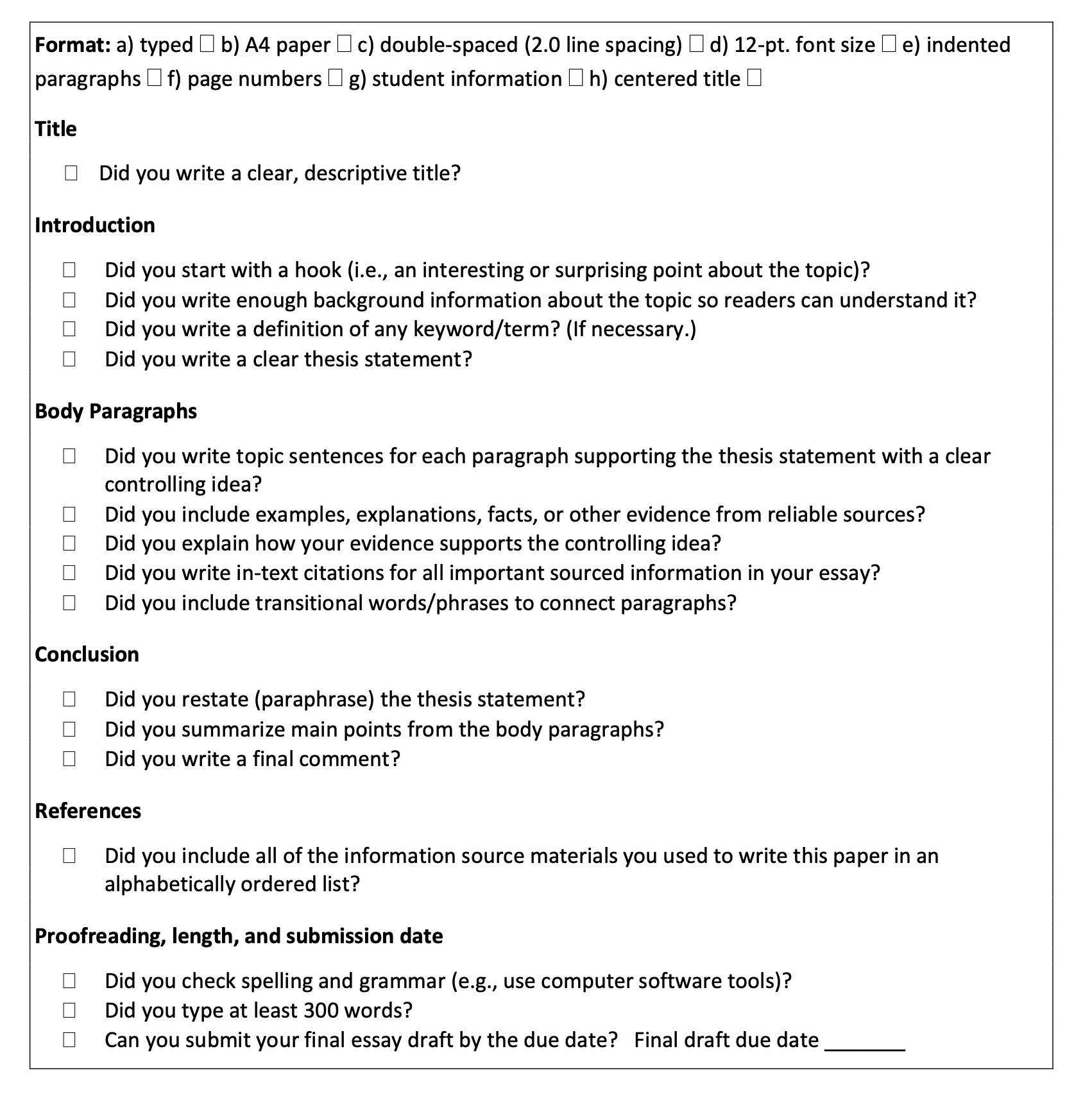
Exercise 6: Use the checklist below to prepare the first draft of your essay. Check the boxes (✓) for each of the items included in your essay draft.
Essay Checklist
FYI
Is it plagiarism? – Computer-generated Translations
With the widespread use of electronic devices, the growing number of users, and the constant improvements of algorithms, computer-based translators and generative AI (e.g., Google Translate, Weblio, ChatGPT) have become very useful and incredibly precise. However, great caution should be taken in using these platforms for academic writing. Remember, all outside sources, no matter the language, should be cited in your writing. That means taking information from a Japanese website, translating it into a web-based translator, and using it in your essay without paraphrasing and proper sourcing is plagiarism. Paraphrase information in your own words, and don’t forget to add the citation for the source. Finally, when in doubt, ask your teacher. For more information on academic writing standards at Kyoto University, see the FYI in Chapter 8.